Accurate lifetime prediction and safety validation for EV battery cells, modules, and packs rely heavily on simulated environmental stress. You cannot engineer reliable power systems without pushing them to their environmental limits. Inadequate thermal management testing leads to delayed detection of micro-cracking, loss of active materials, and unpredictable thermal runaway under high C-rate dynamics. These hidden flaws inevitably emerge late in validation phases or, worse, inside customer vehicles.
Executing precise temperature profiles, controlled ramp rates, and sufficient dwell times using a purpose-built EV Battery Thermal Cycling Chamber minimizes these warranty risks. This rigorous approach ensures strict compliance with international standards like UN 38.3 and IEC 62660. We designed this article to provide a clear framework. You will learn how to define precise thermal cycling test parameters and evaluate the equipment required to execute them reliably at scale.
Key Takeaways
Profile Dynamics: Dynamic temperature profiles must account for both ambient environmental extremes and internal heat generation during dynamic charge/discharge cycles.
Ramp & Dwell Criticality: High ramp rates induce necessary thermo-mechanical fatigue, while calculated dwell times ensure complete thermal equilibrium—especially critical for large format EV packs exceeding 45°C.
Chamber Selection: Procurement of an EV battery thermal cycling chamber requires aligning compressor capacity, EUCAR safety ratings, and BMS integration capabilities with the laboratory's throughput requirements.
The Business Impact of Validated Battery Thermal Models
Thermal cycling provides the empirical foundation for battery safety and longevity. When engineering teams validate battery thermal models effectively, the ripple effects positively impact the entire product lifecycle.
Warranty and Liability Mitigation: Extreme temperatures expose fatal chemical vulnerabilities. Sub-zero environments trigger irreversible lithium plating. High temperatures accelerate Solid Electrolyte Interphase (SEI) layer breakdown. Uncovering these degradation mechanisms before mass production reduces expensive field failures and mitigates safety liabilities.
Predictive Lifetime Modeling: Reliable empirical data from thermal cycling directly feeds into advanced rainflow-counting algorithms. These dynamic thermal models allow engineers to estimate a battery pack's State of Health (SoH) accurately over a 10-15 year vehicle lifespan. You can predict capacity fade long before the first vehicle hits the road.
Accelerated Time-to-Market: Standardized, repeatable thermal profiling shortens the entire validation phase. By establishing automated test sequences, you accelerate R&D cycles without compromising the rigor of necessary safety assessments.
Defining the Temperature Profile for EV Applications
Creating an effective temperature profile requires looking beyond basic ambient climate conditions. You must simulate the intense internal heat generated by the battery itself.
Standard vs. Custom Profiles
Engineers must differentiate between standardized compliance profiles and dynamic real-world profiles. Standard profiles, such as those found in UN 38.3, focus on steady-state cycling. They verify basic transportation safety and structural integrity. However, steady-state tests ignore real-world driving behaviors.
Custom dynamic profiles mimic actual road conditions. They integrate high C-rate bursts representing rapid acceleration and sudden regenerative braking. These bursts create massive internal thermal loads. Testing standard ambient conditions alongside high C-rate profiles gives you a complete picture of battery endurance.
Table 1: Profile Comparison Overview
Profile Type | Primary Objective | C-Rate Dynamics | Test Environment Focus |
|---|---|---|---|
Standard (IEC 62660) | Baseline safety and compliance | Steady, consistent charge/discharge | Ambient extreme soaking |
Custom Dynamic | Real-world lifetime prediction | Spiky, rapid burst cycles | Internal heat vs. cooling systems |
High-Temperature Extremes (>45°C)
Testing environments exceeding 45°C place immense strain on the Battery Thermal Management System (BTMS). The goal here is evaluating BTMS performance under sustained high-heat loads. When active cooling systems fail to dissipate heat fast enough, localized hotspots form. These tests help you identify cooling system bottlenecks before they compromise cell integrity.
Sub-Zero Protocols
Freezing profiles evaluate crucial cold-cranking performance. Cold environments drastically reduce lithium-ion mobility. If you apply rapid charging protocols at -10°C, you risk severe lithium dendrite formation. These microscopic metal spikes can pierce the separator, causing internal short circuits. Sub-zero profiling ensures the Battery Management System (BMS) accurately throttles charge rates in freezing conditions.
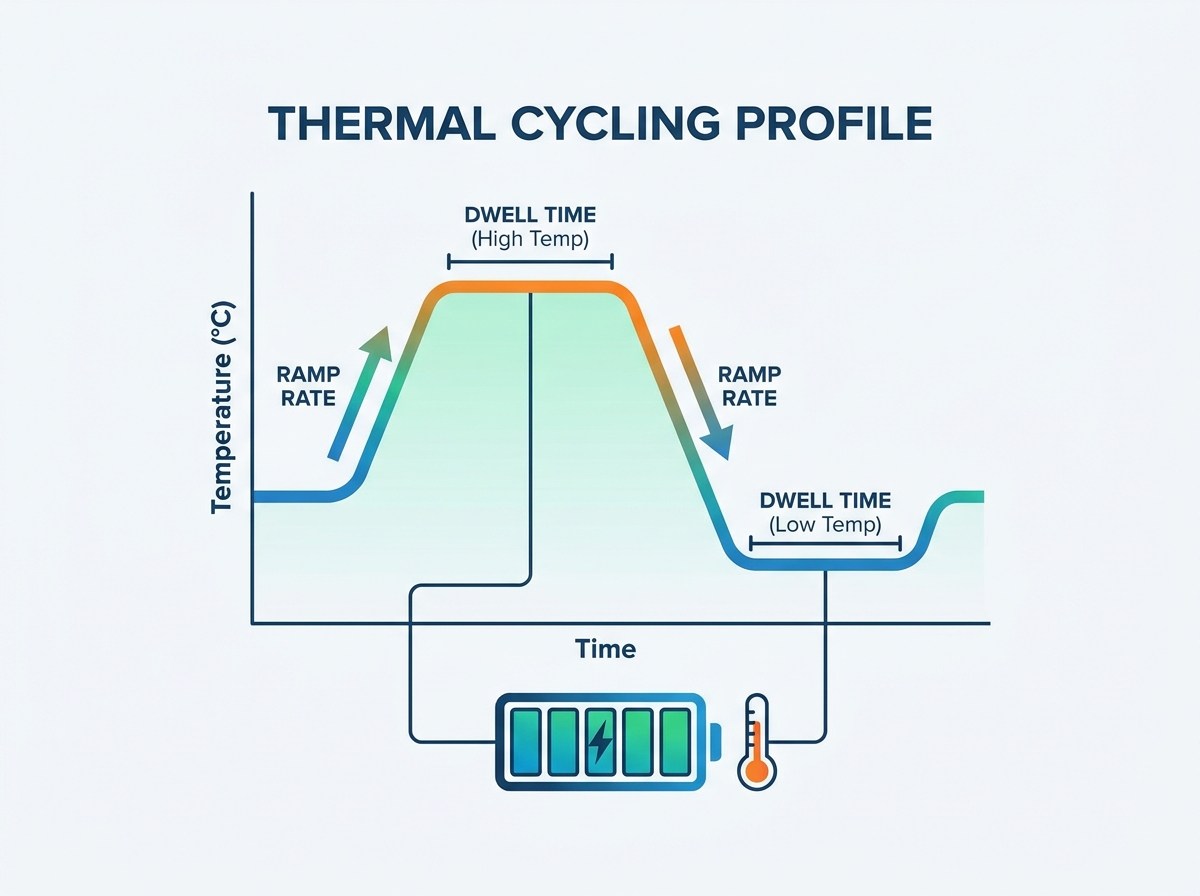
Ramp Rate and Dwell Time: Engineering the Stress Multipliers
Temperature extremes alone do not break robust batteries. The speed of temperature change and the duration of the soak act as the true stress multipliers.
Ramp Rates (Heating & Cooling)
Standard EV battery test protocols typically specify ramp targets between 3°C and 15°C per minute. These rapid temperature shifts force different materials inside the cell to expand and contract at different speeds. High ramp rates effectively test the mechanical durability of internal cell packaging, busbars, and delicate ultrasonic welds.
It is crucial to explain the distinction between standard thermal cycling and thermal shock testing. Thermal cycling utilizes controlled compressor ramps to continuously test expansion and contraction fatigue. Thermal shock testing physically moves the Device Under Test (DUT) between two separate extreme temperature zones within seconds. Shock testing looks for immediate catastrophic failure limits, while cycling evaluates long-term thermo-mechanical fatigue.
Dwell Time Physics
Dense EV battery packs suffer from severe thermal lag. When the chamber air reaches a target of 60°C, the center cells inside a heavy pack might still sit at 25°C. You cannot rely on ambient chamber sensors alone.
You must calculate dwell time based on the mass and specific heat capacity of the DUT. This ensures core thermal equilibrium, not just superficial surface temperature achievement. Proper dwell time guarantees all cells experience the intended environmental stress equally.
Steps to Establish Accurate Dwell Times:
Embed deeply placed thermocouples inside a non-active "dummy" version of the battery pack.
Execute a maximum temperature ramp in the test chamber.
Record the exact time delay between the chamber reaching the setpoint and the deepest thermocouple matching that temperature.
Add a 15% safety buffer to this time value to form your baseline dwell time parameter.
Evaluating an EV Battery Thermal Cycling Chamber: Key Procurement Criteria
Test accuracy depends entirely on your hardware capabilities. Selecting the right equipment requires balancing thermal power, facility safety, and data integration.
Thermal Load Capacity
Large EV packs actively generate high-wattage heat during concurrent charge and discharge cycling. Your chamber must overpower this active heat load. Assessing the chamber's ability to maintain tight temperature tolerances (±0.5°C) under active load is critical. If the internal compressor lacks sufficient cooling capacity, the battery's self-generated heat will cause the chamber temperature to spike wildly out of specification.
Safety and Compliance Integration
Testing high-density lithium-ion batteries carries inherent risks of thermal runaway. Evaluating EUCAR Hazard Level ratings is non-negotiable for lab safety.
Safety Integration Chart: EUCAR Hazard Levels & Chamber Mitigations
EUCAR Hazard Level | Expected Behavior | Required Chamber Mitigations |
|---|---|---|
Level 4 | Venting of toxic or flammable gases | Rapid gas exhaust systems, toxic gas monitoring |
Level 5 | Fire or aggressive combustion | Spark-resistant interiors, integrated fire suppression |
Level 6 | Explosion or catastrophic rupture | Explosion-relief pressure venting, nitrogen purging systems |
Chambers rated for Levels 4 through 6 require heavy structural reinforcements and automated fail-safes. The safety system must act independently of the main controller to guarantee rapid response during a catastrophic event.
Data Acquisition & Cycler Synchronization
A modern EV Battery Thermal Cycling Chamber does not operate in isolation. You need seamless software handshakes between the chamber controller, battery cyclers, and the internal Battery Management System (BMS). Synchronous data logging prevents corrupted datasets. When the cycler commands a heavy discharge, the chamber software must log the corresponding environmental response precisely to the millisecond.
Implementation Realities and Lab Facility Constraints
Upgrading test capabilities requires careful planning around facility limitations. Ignoring physical infrastructure constraints leads to project delays and compromised test schedules.
Footprint and Facility Utilities
Engineering teams must analyze trade-offs between air-cooled and water-cooled condenser systems. Air-cooled chambers offer simpler installations but struggle to dissipate the massive heat generated during large pack testing. Water-cooled systems handle heavier thermal loads effortlessly. However, they demand robust facility chilled water loops and advanced plumbing infrastructure. Furthermore, large walk-in chambers demand immense electrical power supplies. You must verify your facility's peak amperage limits before installation.
Calibration and Maintenance Overheads
Extreme test conditions degrade equipment over time. Factoring in the ongoing overhead of sensor calibration guarantees long-term data validity. Refrigeration system maintenance becomes a frequent necessity. Managing the mechanical wear-and-tear from continuous high-stress operations (like sustained 15°C/min ramps) requires a dedicated preventative maintenance schedule.
Best Practices for Lab Maintenance:
Schedule multi-point temperature calibrations every six months.
Inspect chamber door seals weekly for micro-leaks caused by rapid thermal expansion.
Flush water-cooling loops annually to prevent mineral scaling and optimize heat transfer.
Scalability Risk
Avoid under-sizing the chamber during initial procurement. You must account for future test requirements. Moving from cell-level testing today to module or full pack-level testing tomorrow demands significantly more physical volume and cooling power. A modular chamber approach prevents your R&D lab from outgrowing its own equipment in less than three years.
Conclusion
Effective thermal cycling is a delicate balance of aggressive temperature profiles, precise ramp rates, and mathematically sound dwell times. Pushing battery limits in a controlled environment is the only reliable way to uncover latent defects before they reach the consumer.
Successful execution fundamentally relies on the performance limits and safety infrastructure of your testing hardware. Standard off-the-shelf climate chambers cannot handle the active thermal loads or extreme safety hazards inherent to large EV battery packs.
Engineering and procurement teams should audit their current dynamic thermal models against their existing hardware capabilities immediately. Identify specific gaps in compressor capacity, EUCAR safety compliance, or battery cycler integration. Upgrading your testing infrastructure now ensures faster development cycles and drastically reduces downstream liability risks.
FAQ
Q: What is the difference between thermal cycling and thermal shock for EV batteries?
A: Thermal cycling uses controlled ramp rates to test continuous expansion/contraction, while thermal shock moves the DUT between separate extreme temperature zones in seconds to test immediate catastrophic failure limits.
Q: How do you determine the correct dwell time for a 100kWh battery pack?
A: Dwell time is determined through initial profiling using core-embedded thermocouples to measure the time required for the internal cell centers to match the chamber's ambient setpoint, accounting for the pack's thermal mass.
Q: What EUCAR hazard level should an EV battery thermal cycling chamber support?
A: For testing active lithium-ion cells and modules to failure, chambers typically require features supporting EUCAR Hazard Levels 5 or 6, necessitating explosion-relief venting and advanced fire suppression.
Q: Can thermal chambers sync directly with standard battery cyclers?
A: Yes, modern commercial chambers offer CAN/Ethernet integration, allowing the battery cycler to act as the master controller, triggering temperature profiles based on the charge/discharge state.