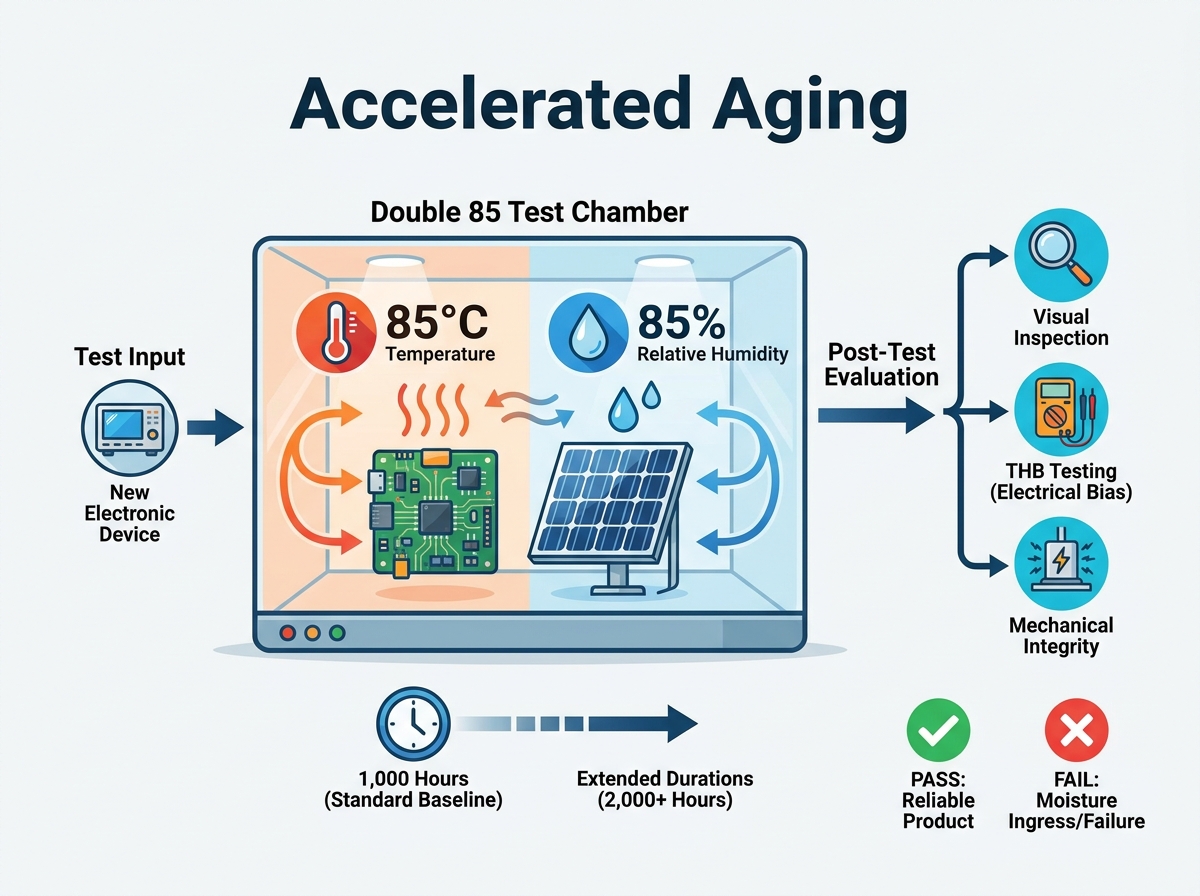
Premature field failures of electronics, photovoltaics, and encapsulants carry severe financial and reputational costs. Modern manufacturers cannot afford unexpected breakdowns in the field. They require guaranteed product reliability under extreme conditions. To achieve this, engineers rely on the Double 85 test. We define this protocol as sustaining 85°C and 85% Relative Humidity. It functions as the ultimate industry-standard accelerated aging test. It reliably determines moisture resistance and long-term durability.
We created this article to provide an evidence-based framework for executing the test properly. You will learn to understand complex evaluation criteria. Furthermore, we will guide you in selecting the correct testing equipment. Mastering these elements ensures your products survive harsh environments and meet strict compliance standards.
Key Takeaways
Core Parameters: The Double 85 test sustains 85°C and 85% RH, simulating severe environmental stress to accelerate moisture ingress and degradation.
Duration Benchmarks: While 1,000 hours is the baseline standard for many industries, durations vary based on specific compliance frameworks (e.g., JEDEC, IEC).
Evaluation Accuracy: Meaningful results require precise post-test evaluations, including Temperature Humidity Bias (THB) testing to monitor electrical degradation under load.
Equipment Imperatives: Executing a continuous 1,000+ hour test requires a specialized testing chamber with fail-safes for power interruptions, sensor drift, and water purity.
The Business Case for Double 85 Testing: Standards and Compliance
Moisture penetration destroys sensitive components rapidly. Water molecules enter microscopic cracks in protective casings. They cause severe delamination between polymer layers. Moisture also corrodes the microscopic metal traces on printed circuit boards (PCBs). Over time, this creates electrical shorts. The Double 85 test deliberately isolates humidity as the primary failure mechanism. It forces this exact degradation process in a controlled environment. This creates a highly measurable baseline. Manufacturers use this baseline to validate product warranties.
Industries rely on strict frameworks to standardize this testing. Following recognized standards proves your authoritativeness in the market. It shows customers you take reliability seriously. The most common industry frameworks include:
Semiconductors and Electronics: Engineers follow JEDEC JESD22-A101. This dictates the Temperature Humidity Bias (THB) life test. It ensures microchips survive sustained damp heat while powered.
Solar and Photovoltaics: Solar panels face decades of outdoor exposure. Manufacturers use IEC 61215 to evaluate damp heat effects on PV modules.
Automotive and Adhesives: Carmakers develop custom OEM standards. They test potting compounds and conformal coatings under severe stress.
You must define clear success criteria before testing begins. Passing the Double 85 test implies a high probability of survival. It proves your product can endure expected field conditions. It confirms the device resists moisture-induced failure. Achieving these results justifies market release and protects your brand reputation.
Standard Test Durations: Aligning Time with Lifecycle Expectations
Test durations vary significantly based on your product category. You must align the testing timeline with actual lifecycle expectations. Setting the wrong duration either wastes time or misses critical flaws.
The 1,000-Hour Baseline
Most industries accept 1,000 hours as the universal baseline. This equals roughly 42 days of uninterrupted testing. It stands as the standard threshold for establishing baseline reliability. A 1,000-hour run effectively mimics years of outdoor environmental exposure. If a component survives this duration, it generally performs well in harsh field conditions.
Extended Durations (2,000 to 3,000 Hours)
Some applications demand exceptionally high reliability. You will see extended test durations in aerospace and medical devices. Premium solar panels with 25-year warranties also require longer testing. These items must undergo 2,000 to 3,000 hours of constant exposure. Extended durations reveal latent material defects. They highlight slow-acting chemical breakdowns.
Shorter Durations (500 Hours)
Not every product needs 42 days of testing. Consumer electronics often use shorter 500-hour durations. Rapid prototyping cycles also benefit from reduced testing times. Extended testing creates severe bottlenecks during early product development. A 500-hour test quickly highlights fundamental design flaws. You can then correct these flaws before committing to a full 1,000-hour run.
The Decision Factor
Test duration directly dictates your testing capacity. A single 1,000-hour test ties up equipment for six weeks. Longer tests require serious logistical planning. You must choose your testing strategy carefully. You either rely on outsourced lab testing or purchase high-capacity in-house equipment. Outsourcing works well for infrequent needs. In-house testing provides better control for continuous production.
Typical Double 85 Test Durations by Industry Application
Industry / Product Type | Standard Duration | Primary Testing Goal |
|---|---|---|
Consumer Electronics | 500 Hours | Rapid verification of conformal coatings and basic PCB seals. |
Standard Semiconductors | 1,000 Hours | Baseline JEDEC compliance for moisture resistance. |
Automotive Components | 1,000 - 2,000 Hours | Verification of potting compounds under under-hood conditions. |
Premium Solar Panels | 2,000 - 3,000 Hours | Simulation of 25+ years of outdoor damp heat exposure. |
Evaluation Methods: Measuring Degradation and Success
Running the test is only the first step. Meaningful results require precise evaluation methods. You must measure the exact level of degradation accurately.
Temperature Humidity Bias (THB) Testing
Passive exposure does not tell the whole story. THB testing applies active electrical bias during the test. You supply a continuous voltage to the component. This simulates real-world active operation. The applied voltage rapidly accelerates galvanic corrosion. It forces conductive metals to migrate across insulators. THB testing remains essential for evaluating active electrical reliability.
Visual and Microscopic Inspection
You must perform thorough visual inspections post-exposure. Engineers utilize high-powered microscopes to find hidden damage. You should look for delamination between substrate layers. Check protective coatings for blistering or cracking. Note any potting compound reversion, where solid resins turn soft. Finally, spot any dendrite growth between electrical traces.
Electrical Performance Metrics
Moisture fundamentally changes electrical properties. You must measure insulation resistance carefully. High humidity often causes insulation to degrade. Next, test the leakage current across components. Excessive leakage indicates severe internal moisture ingress. Finally, verify the overall dielectric strength. A compromised dielectric leads to immediate catastrophic failure in the field.
Mechanical Integrity
Damp heat severely weakens structural bonds. You must evaluate the mechanical integrity of adhesives. Perform shear strength tests on bonded joints. Conduct peel strength tests on laminates. Prolonged 85/85 exposure often destroys weak adhesives. Verifying mechanical strength ensures the product physically holds together.
Key Evaluation Criteria for Selecting a Double 85 Test Chamber
Executing a 1,000+ hour test requires specialized testing equipment. Standard environmental chambers often fail under continuous extreme stress. You must evaluate equipment based on strict endurance criteria.
Long-Term Stability and Uniformity
Temperature and humidity fluctuations ruin test data. The Double 85 Test Chamber must maintain precise conditions. It should hold ±0.5°C and ±2.5% RH constantly. It must sustain this uniformity continuously for over 1,000 hours. The system must operate without any manual intervention. Flawless stability ensures reproducible and trustworthy results.
Water Purification and Management
Standard tap water destroys humidity generators. Tap water contains minerals. These minerals create severe scale buildup during continuous boiling. Scale ruins heating elements rapidly. You must evaluate chambers featuring integrated RO (Reverse Osmosis) systems. Automated demineralization is absolutely essential. These purification systems allow the chamber to survive continuous 40-day runs safely.
Condensation Prevention (Anti-Drip)
High humidity creates condensation inside the workspace. Ceiling condensation dripping onto test units acts as a destructive anomaly. Water drops will invalidate a 1,000-hour test immediately. You must look for specialized anti-drip features. Heated viewing windows prevent front-glass condensation. Sloped internal ceiling architectures direct water droplets away from your test samples.
Data Logging and Compliance Security
Auditors require absolute proof of compliance. Digital records must prove uninterrupted adherence to the 85/85 parameters. You need highly secure, encrypted data logging. The system should export detailed trend graphs easily. Furthermore, independent sensor calibration ports remain necessary. They allow third-party technicians to verify sensor accuracy without disrupting the chamber wiring.
Energy Efficiency for Steady-State
Because the chamber runs constantly for weeks, efficiency matters deeply. Compressor efficiency impacts operational stability. High-quality thermal insulation prevents heat leakage. Good insulation reduces the constant strain on heating elements. Prioritizing steady-state efficiency ensures the machine runs smoothly. It prevents mechanical overheating during long test cycles.
Implementation Realities and Common Failure Risks
Even the best testing strategies encounter physical realities. Long-duration testing presents unique operational risks. You must anticipate these risks to prevent aborted test runs.
Sensor Drift Over Time
Continuous high heat and moisture degrade sensors. Wet-bulb/dry-bulb mechanisms face water contamination. Capacitive humidity sensors can drift over 1,000 hours of continuous exposure. A drifting sensor causes the chamber to over-humidify the workspace.
Common Mistake: Trusting uncalibrated sensors for a full 42-day run without verification.
Mitigation: Implement scheduled mid-test verification. You should also utilize redundant sensor setups to cross-check readings.
Power Interruptions
Continuous power remains critical. A power failure on day 39 of a 40-day test is catastrophic. It ruins weeks of expensive data.
Common Mistake: Plugging long-duration chambers into unbacked electrical grids.
Mitigation: Require chambers with automated recovery modes. These systems log the specific downtime accurately. They safely resume the precise test profile once power returns.
Cross-Contamination
Chemical reactions occur at high temperatures. Testing outgassing polymers alongside sensitive PCBs in the same chamber run causes severe issues. The polymer fumes contaminate the PCB traces. This causes false failures.
Common Mistake: Mixing highly reactive adhesives with bare microchips in a single test batch.
Mitigation: Enforce strict load-isolation protocols. Never mix incompatible materials during a long-duration run.
Conclusion
A successful Double 85 test strategy requires meticulous planning. It relies equally on adhering to strict evaluation standards and deploying reliable equipment. You must isolate moisture as a failure mechanism accurately. You must evaluate THB, electrical leakage, and mechanical strength carefully. Furthermore, you must utilize testing chambers capable of extreme endurance. Standard equipment simply cannot survive 1,000 hours of continuous damp heat.
Your next steps should involve a thorough capacity analysis. We advise engineering teams to calculate their required annual testing hours. Multiply your product lines by your target test durations. This calculation helps you decide between utilizing outsourced lab services or procuring an in-house test chamber. If you run tests frequently, investing in dedicated, high-stability equipment ensures you maintain total control over product reliability.
FAQ
Q: What is the difference between a Double 85 test and a PCT (Pressure Cooker Test)?
A: PCT uses high pressure to force moisture into components much faster. A PCT run often concludes in just 96 hours. However, the Double 85 test remains more representative of actual field conditions. It achieves reliable results without creating unrealistic failure modes caused by extreme pressure.
Q: How many days is a 1,000-hour Double 85 test?
A: A 1,000-hour test equals exactly 41.6 days of continuous, uninterrupted operation. It requires specialized equipment designed for long-term steady-state endurance to complete without failure.
Q: Do I need to apply power to my device during an 85/85 test?
A: You only apply power if you follow a Biased (THB) test standard. Unbiased tests focus purely on physical material degradation. Biased tests evaluate active electrical reliability and accelerate galvanic corrosion.
Q: Can a standard environmental chamber perform a Double 85 test?
A: Yes, provided it possesses specific endurance features. It must have automated water purification, high-capacity boilers, long-term stability controls, and condensation prevention mechanisms required for extended damp-heat cycles.