Environmental testing often becomes a critical bottleneck in modern product development. Teams face immense pressure to validate complex components rapidly. Inaccurate environmental simulation invariably leads to false positives. These critical errors trigger compliance failures and disastrous product recalls. You need reliable testing environments to prevent these costly downstream issues entirely.
We will define how a Constant Temperature Humidity Test Chamber achieves true thermodynamic stability. You will understand verifiable industry applications driving its global adoption. Furthermore, we will provide a strict framework covering precise test setup and procurement evaluation.
Lab managers, quality assurance engineers, and procurement teams will find this guide highly actionable. It delivers the technical clarity necessary for evaluating advanced test equipment. You will learn to navigate complex hardware choices required by rigorous compliance-driven programs.
Key Takeaways
Precision relies on the synchronized interplay of PID controllers, mechanical refrigeration, and steam/vapor injection systems to maintain strict spatial uniformity.
Proper test setup—specifically regarding sample volume, airflow disruption, and live heat loads—is as critical to test validity as the chamber's hardware.
Procurement evaluation must look beyond baseline specs to assess thermal fluctuation margins and sensor calibration standards.
Compliance with stringent international standards (e.g., IEC, MIL-STD) requires documented calibration and traceable control logic.
Core Working Principle of a Constant Temperature Humidity Test Chamber
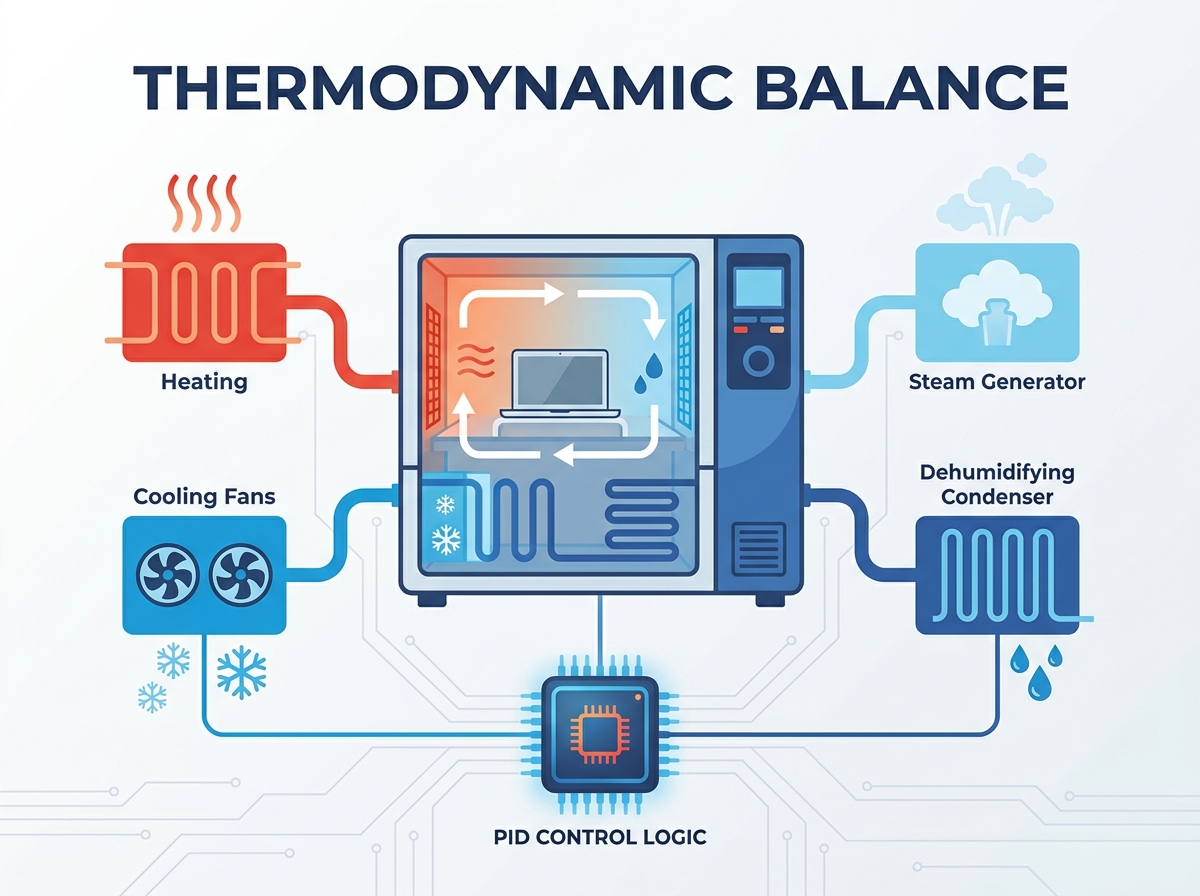
A test chamber operates as an advanced thermodynamic ecosystem. Heating, cooling, humidification, and dehumidification must balance perfectly. The system commands these forces simultaneously. A Constant Temperature Humidity Test Chamber monitors continuous feedback loops to maintain exact set points.
Temperature Regulation
Cooling relies entirely on mechanical compression refrigeration cycles. Compressors pressurize gaseous refrigerants rapidly. Condensers then release the accumulated heat. Expansion valves drop the pressure instantly. Evaporators subsequently absorb heat from the internal chamber atmosphere.
Heating systems utilize bare nichrome wire heaters. These specific elements provide extremely low thermal mass. They offer rapid thermal response times. Solid-state relays control these primary heaters. They execute precise micro-adjustments multiple times per second.
Humidity Regulation
Moisture control involves highly complex phase changes. Adding moisture typically relies on dedicated steam generators. Some models utilize ultrasonic atomizers instead. Vapor absorption requires a specific transition time. The chamber atmosphere needs sufficient time to stabilize and absorb the introduced vapor completely.
Dehumidification employs mechanical refrigeration coils. These active coils act as a deliberate cold spot. The coil temperature drops below the current atmospheric dew point. Ambient moisture condenses out of the air. The resulting water drains away securely from the workspace.
The Role of PID Controllers
Proportional-Integral-Derivative (PID) controllers govern the entire mechanical process. PID algorithms prevent dangerous temperature overshoots. Proportional control reacts directly to the current error. Integral control accounts for past accumulation. Derivative control predicts future thermal trends. They work together seamlessly. This advanced logic ensures the tight tolerances demanded by strict testing standards.
High-Stakes Uses and Industry Compliance Standards
Different industries face uniquely demanding environmental challenges. Products must survive rigorous expected lifetimes. The equipment does much more than merely stress products. It serves as a strict legal requirement. Market-entry certification demands documented proof of survivability.
Electronics & Semiconductors
Electronics undergo aggressive accelerated life testing (ALT). Engineers cycle temperatures rapidly. They identify latent solder joint fractures. Thermal expansion mismatches cause these specific fractures over time. Teams also assess conformal coating integrity. They follow IEC 60068 standards rigorously to ensure global compliance.
Pharmaceuticals & Packaging
Pharmaceuticals require prolonged, unbroken stability testing. Teams must validate strict shelf-life claims. They expose blister packs to steady, unyielding moisture. They follow ICH Q1A regulatory guidelines. Failures here directly compromise human safety.
Automotive & Aerospace
Automotive sectors demand brutal cyclic testing. Components must survive extreme environmental shifts. Engine control modules face rapid humidity spikes daily. Engineers follow MIL-STD-810 protocols. These intense tests simulate decades of harsh field use.
Table: Common Industry Testing Standards
Industry | Core Focus Area | Key Standard | Primary Engineering Challenge |
|---|---|---|---|
Electronics | Solder reliability | IEC 60068 | Thermal expansion mismatch |
Pharmaceuticals | Shelf-life stability | ICH Q1A | Moisture ingress prevention |
Automotive | Under-hood simulation | MIL-STD-810 | Rapid cyclic extremes |
Best Practices for Test Setup and Execution
Test execution matters just as much as hardware quality. Proper physical setup prevents skewed data. You must control the internal variables carefully.
Sample Placement & Chamber Load Constraints
The 1/3 Rule: Active test samples must follow strict spatial limits. They should never occupy more than one-third of the internal volume. This critical spacing ensures proper airflow. It guarantees strict spatial uniformity across all devices.
Baffling & Blockage: Avoid placing flat surfaces parallel to the airflow stream. Solid blocks create aerodynamic shadowing. Baffling creates stagnant dead zones behind large objects. You must elevate products using specialized wire racks.
Managing Live Heat Loads
Managing live loads requires careful thermal calculation. Active electronic devices under test (DUT) generate internal heat. Operators must compensate for this live load constantly. You need sufficient cooling capacity to offset DUT heat generation. If a power supply emits 500 watts, the compressor must absorb it entirely.
Sensor Placement
Sensor placement heavily influences overall test validity. Relying solely on built-in control sensors introduces significant risk. The main control sensor measures air near the return duct. It does not measure the actual product. We strongly advocate attaching external PT100 thermocouples. Place them directly onto the DUT. This direct approach provides true localized thermal readings.
Cable Routing
Cable routing demands strict operational discipline. Access ports allow necessary power cable entry. Always seal them using specialized silicone plugs. Utilize thermal breaks to prevent exterior condensation. Poor sealing compromises the atmospheric seal completely. It forces the humidity system to overwork.
Bottom-of-Funnel Evaluation Criteria: Specifying Your Chamber
Procurement requires evaluating deep technical specifications. You must differentiate marketing claims from verifiable thermodynamic capabilities. Follow these structured evaluation criteria before making any purchasing decision.
Analyze Performance vs. Specifications: Differentiate control fluctuation from spatial uniformity. Control fluctuation measures temporal stability at one sensor. A high-quality system achieves ±0.3°C fluctuation easily. Spatial uniformity measures variance across the entire physical workspace. Excellent uniformity hovers around ±2.0°C.
Identify Hardware Quality Indicators: Look for recognizable premium compressor brands. Compressors act as the beating heart of the system. Evaluate inner chamber materials carefully. Manufacturers typically use SUS304 stainless steel. It resists severe corrosion from long-term humidity exposure. It also prevents internal contamination.
Ensure Form Factor Alignment: Align the physical form factor to your operational needs. Benchtop and reach-in models suit modular testing perfectly. They handle smaller printed circuit boards effectively. Walk-in systems accommodate bulky assemblies like battery packs. Maintaining uniformity in large volumes proves highly challenging. Custom directed ducting becomes absolutely necessary for large rooms.
Demand Robust Data Logging and Export: Data logging requires traceable, secure records. Audit compliance depends on strict software protocols. CFR 21 Part 11 mandates non-editable electronic signatures. You need highly secure export formats. PDF or encrypted CSV files protect your data integrity against tampering.
Implementation Risks
Integrating environmental testing equipment requires significant facility preparation. You must anticipate operational dependencies. Ignoring these physical requirements will severely limit machine performance and lifespan.
Facility Requirements
Installation requires specific facility adaptations. You often need dedicated 3-phase power drops. High-capacity heaters draw significant electrical amperage. Floor load-bearing limits must support heavy machinery safely. Walk-in units weigh several tons. Ambient lab climate control remains strictly mandatory. The lab must stay near 23°C for optimal condenser heat rejection.
Water Quality Dependencies
Water quality heavily impacts long-term performance. Demineralized or Reverse Osmosis (RO) water is absolutely critical. Water conductivity should remain below 10 micro-Siemens. Pure water prevents hard scale buildup. Scale destroys humidity heaters rapidly. Pure water also protects delicate wet-bulb sensors from dangerous mineral fouling.
Refrigerant Phase-Outs
Modernize your refrigerant strategy before purchasing. Regulatory bodies constantly phase out high-GWP refrigerants. Evaluate systems based on modern low-GWP alternatives exclusively. This proactive step ensures long-term serviceability. It protects your lab against future refrigerant shortages and regulatory fines.
Calibration Frequency
Factor in mandatory calibration frequency requirements. ISO 17025 accredited calibrations maintain operational validity. You should schedule these annually or semi-annually. Certified technicians must calibrate temperature and humidity probes precisely. Rigorous calibration documents prove your ongoing compliance to strict external auditors.
Conclusion
A test chamber operates as a highly sophisticated thermodynamic system. It is never just a simple laboratory appliance. Success demands matching hardware capabilities to strict compliance standards. You must also enforce rigorous test setup protocols continuously.
Define your maximum DUT size carefully. Calculate your heaviest expected live heat load accurately. Identify your strictest testing standard before ever requesting quotes. Take deliberate action to secure highly accurate testing.
Consult experienced technical sales engineers for custom sizing. They will help tailor the thermodynamic capacity to your precise needs. You will eliminate testing bottlenecks permanently. You will accelerate your product development lifecycle confidently.
FAQ
Q: What is the difference between relative humidity (RH) and absolute humidity in testing?
A: Absolute humidity measures the exact mass of water vapor present in the air. Relative humidity (RH) measures the current vapor percentage relative to the maximum amount the air could hold at a specific temperature. A Constant Temperature Humidity Test Chamber controls RH by constantly adjusting both dry-bulb temperatures and active moisture injection simultaneously.
Q: How long does it take for a chamber to stabilize after opening the door?
A: Stabilization time depends on the ambient climate and chamber capacity. It typically takes 10 to 30 minutes to recover strict temperature and humidity set points. Opening the door vents conditioned air and introduces ambient moisture immediately. You should always use sealed access ports for routing cables instead of keeping doors ajar.
Q: Can a constant temperature and humidity test chamber perform rapid thermal shock?
A: No. Steady-state and cycling chambers ramp temperatures gradually. They use a single workspace to transition environments. Thermal shock testing requires dedicated dual-zone or triple-zone chambers. These specific shock chambers physically move the product between distinct hot and cold zones to induce immediate, violent thermal stress.
Q: Why is my humidity system failing to reach 95% RH at high temperatures?
A: Reaching extremely high RH at elevated temperatures requires immense vapor generation. Psychrometric limitations often cause this failure. Ensure your water supply flows freely and your steam generator operates correctly. A fouled wet-bulb sensor or scaled heater elements will also prevent the system from accurately measuring and achieving peak humidity.