Modern battery development demands rigorous and uncompromising testing. Engineers routinely push volatile chemistries to their absolute limits to gather critical data. You need reliable performance metrics, but you absolutely cannot compromise on laboratory safety. A standard climatic enclosure simply cannot handle sudden, violent energy releases. Configuring a dedicated Battery Explosion-Proof Test Chamber represents a vital engineering investment. It protects your facility infrastructure. It also keeps personnel safe from unpredictable thermal runaway events. Thermal runaway presents highly complex challenges, including rapid pressure spikes and toxic gas emissions. This guide details the essential configuration parameters you need to mitigate these risks effectively. You will learn how to align hardware specifications with strict global testing standards. We will also explore how to integrate smart safety interlocks. These steps ensure accurate, repeatable performance testing while maintaining a secure operational environment.
Key Takeaways
Safety Integration: Explosion-proofing extends beyond structural integrity to include active venting and fire suppression synchronization.
Hazard Mitigation: Proper chamber configuration must account for gas detection, pressure relief, and automated E-stop protocols based on battery chemistry.
Compliance Alignment: Aligning hardware specifications with UL 2580, IEC 62660, and EUCAR hazard levels is non-negotiable.
Scalability: Future-proofing involves modular design that accommodates evolving pack/module sizes and increasing energy densities.
Understanding the Risks: Defining Your Safety Parameters
Thermal runaway dynamics vary wildly between different battery chemistries. You must understand these variations to configure your equipment correctly. An NMC (Nickel Manganese Cobalt) cell reacts very differently than an LFP (Lithium Iron Phosphate) cell. NMC batteries typically release significant oxygen during a catastrophic failure. This released oxygen fuels intense, fast-burning fires. LFP cells exhibit higher thermal stability and might not ignite as quickly. However, they produce massive volumes of toxic, flammable gases when they vent. If these gases accumulate, they create a severe explosion hazard.
To standardize safety protocols, the automotive and battery industries rely on EUCAR hazard levels. Categorizing your testing protocols by EUCAR levels (ranging from 0 to 7) dictates the specific structural reinforcement you need.
EUCAR Hazard Level Classification Summary
EUCAR Level | Event Description | Typical Chamber Requirement |
|---|---|---|
Level 3 | Leakage (no fire or rupture) | Basic gas extraction, standard door seals |
Level 4 | Venting (visible gas emission) | Active ventilation, real-time gas detection |
Level 5 | Fire or Rupture | Automated fire suppression, pressure relief |
Level 6 | Explosion | Reinforced walls, rupture disks, blast chains |
When configuring testing infrastructure, you must weigh your capital investment against the severe liabilities of containment failure. A catastrophic explosion destroys expensive testing hardware. It causes prolonged laboratory shutdowns. Most importantly, it threatens human lives. Investing in precise safety parameters prevents these devastating scenarios. You are essentially buying an insurance policy for your research environment.
Essential Hardware Configurations for Risk Mitigation
A robust testing environment requires multiple layers of defense. You cannot rely on any single safety mechanism. A comprehensive approach blends passive structural protections and active intervention systems.
Structural Integrity
Your enclosure's physical shell serves as the final, critical barrier. Manufacturers utilize reinforced chamber walls to absorb intense shockwaves during a violent cell rupture. Explosion-proof door locking mechanisms prevent the heavy door from flying open under extreme pressure. Engineers typically specify heavy-duty mechanical latches or high-strength magnetic locks. Furthermore, pressure relief vents are absolutely mandatory. Engineers often use rupture discs for this purpose. These discs safely direct explosive forces upward or outward through dedicated exhaust paths. This targeted venting prevents the main chamber body from tearing apart.
Active Safety Systems
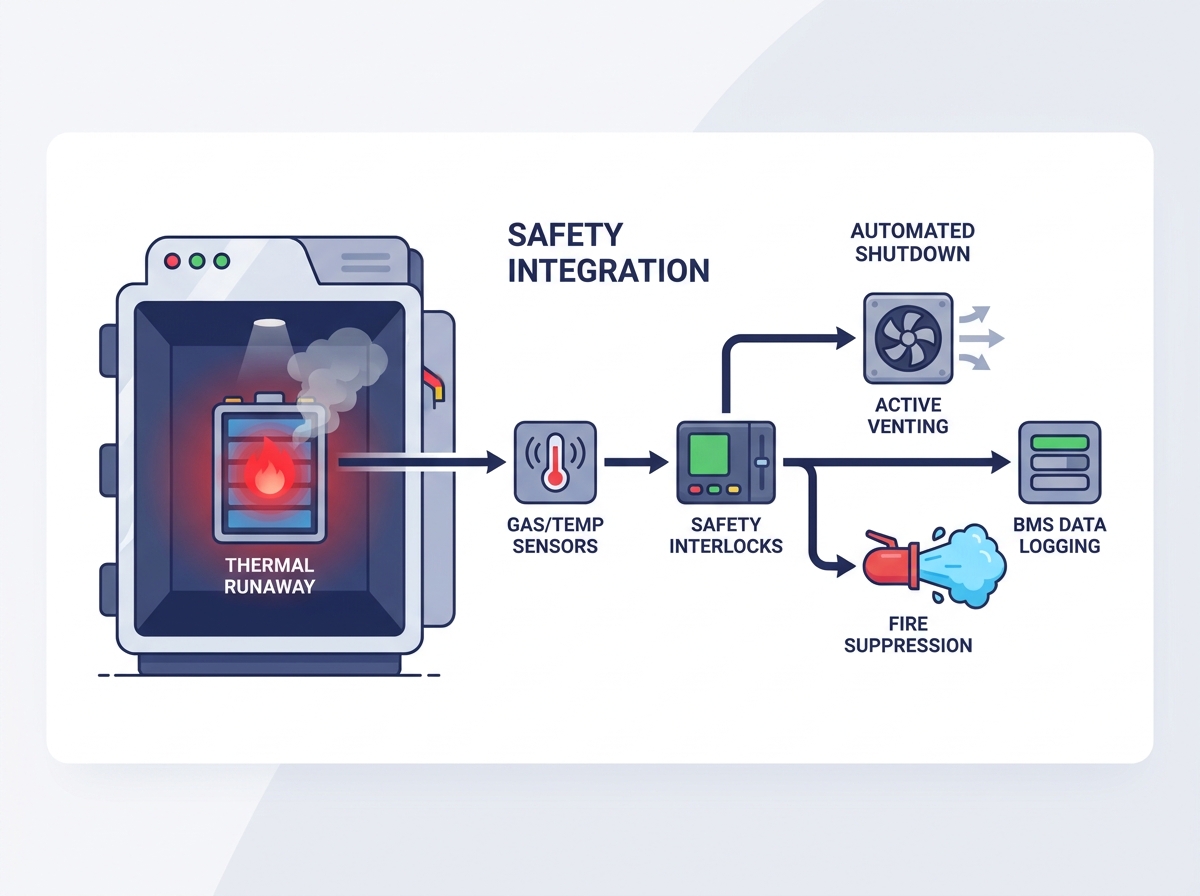
Passive defenses alone are insufficient. You must integrate active safety systems to intervene at the earliest signs of trouble. High-speed gas sensors continuously monitor the internal chamber atmosphere. They quickly detect hydrogen (H2), carbon monoxide (CO), and volatile organic compounds (VOCs). When sensor readings detect a concentration spike, the system triggers automated interventions. The chamber might initiate rapid nitrogen purging to displace oxygen. Displacing oxygen starves potential fires before they ignite. Alternatively, it can deploy CO2 or water-mist fire suppression to cool the event rapidly.
Electrical Isolation
Battery testing involves long-duration cycling at extreme high and low temperatures. You must maintain precise temperature accuracy without compromising safety. Specialized cable ports feature advanced fire-rated insulation. These specialized ports prevent internal flames from escaping through sensor wire pathways. They also protect the delicate internal testing harnesses. This prevents critical cables from melting during a minor venting event.
Common Mistakes to Avoid:
Ignoring rupture disc maintenance and failing to inspect them for metal fatigue.
Testing new cell chemistries without recalibrating H2 and CO sensors first.
Leaving door latches partially engaged or allowing debris to block the seal.
Operational Logic: Integrating Data Acquisition with Safety Interlocks
High-end hardware means very little without intelligent control logic. You need smart operational programming to prevent minor anomalies from becoming major laboratory disasters.
Real-time Interfacing
Connecting chamber controllers directly to your Battery Management System (BMS) is essential. This connection establishes a critical real-time feedback loop. The BMS constantly monitors for abnormal voltage drops. It also watches for rapid, unexplained internal heating. If it detects these anomalies, it transmits an immediate warning signal. The chamber controller receives this data and initiates a pre-emptive shutdown. This stops thermal runaway before it fully develops.
Automated Shutdown Protocols
You must program strict "failsafe" states into your testing software. Operators should never have to guess what to do during a fast-moving emergency. We strongly recommend configuring a standardized, automated shutdown sequence. This removes human error from the equation.
Detection: Fast-acting gas sensors or the BMS flag a critical performance anomaly.
Isolation: The control system instantly cuts all charging currents to the device under test.
Mitigation: Automated blast dampers open immediately. Extraction fans engage at their maximum speed to clear toxic fumes.
Suppression: If internal temperatures continue rising dangerously, nitrogen or CO2 floods the workspace.
Data Integrity during Incidents
Violent thermal events often trigger facility-wide power trips. You cannot afford to lose your testing data during these blackouts. This data holds the key to understanding why the battery failed. You must ensure your black-box data logging functions persist independently. Connect an uninterruptible power supply (UPS) specifically to your data acquisition systems. This ensures critical failure data saves securely, even when active power to the testing chamber cuts out completely.
Installation, Compliance, and Facility Readiness
Procuring the right equipment is only the first step. Proper installation guarantees the system functions exactly as designed when an emergency strikes.
Zoning Requirements
You should isolate high-risk testing zones from general laboratory foot traffic. Equipment positioning matters immensely. Place chambers near exterior building walls to simplify your exhaust routing. Strict ducting and ventilation standards apply to these installations. You must safely exhaust harmful gases generated during a thermal event to the outside atmosphere. Always use spark-proof extraction fans. Employ dedicated, fire-rated stainless steel ductwork. Never tie explosion-proof chamber exhausts into your standard building HVAC system. Doing so risks spreading toxic smoke throughout the entire facility.
Regulatory Compliance
Navigating local and international certifications is critical for legal laboratory compliance. Always verify your equipment meets specific industry standards. Look for UL 2580 and IEC 62660 certifications for automotive battery testing. If you operate in hazardous environments, you may also require ATEX or IECEx certifications. These rigorous certifications prove the chamber's internal electrical components will not ignite a flammable gas mixture.
Operational Training
Even the best engineered equipment fails if personnel operate it incorrectly. Develop highly robust standard operating procedures (SOPs) for your engineering team. Comprehensive training must cover routine battery cycling, emergency response tactics, and post-incident recovery. After a thermal event occurs, operators must know how to inspect the chamber safely. They need crystal-clear guidelines on venting residual explosive gases. They must also learn how to decontaminate the workspace thoroughly before resuming any new tests.
Evaluating Potential Solutions: Shortlisting Criteria
Selecting the right testing partner requires careful, objective evaluation. You must assess both your current testing needs and your long-term research roadmap.
Customization vs. Off-the-Shelf
Determine when a standardized enclosure suffices for your operations. Small-scale cell testing often works perfectly well in off-the-shelf units. However, high-energy capacity testing usually demands bespoke engineering. If your facility tests full electric vehicle battery packs, you face unique challenges. You will need custom reinforced flooring to handle extreme weight. You also need heavy-duty lifting hoists and specialized, large-scale hazard mitigation systems.
Comparison: Custom vs. Off-the-Shelf Testing Solutions
Evaluation Criteria | Off-the-Shelf Solutions | Custom Engineered Solutions |
|---|---|---|
Procurement Lead Time | Relatively Fast (weeks) | Considerably Slow (months) |
Testing Scalability | Limited tightly to standard sizes | Highly adaptable to massive packs |
Max Hazard Level | Usually accommodates up to EUCAR 5 | Can be heavily engineered for EUCAR 6/7 |
System Integration | Utilizes standard I/O protocols | Offers deep, bespoke BMS integration |
Maintenance of Safety Systems
Unexpected downtime constantly disrupts your critical testing schedules. Compare the serviceability of pressure relief systems across different chamber manufacturers. Evaluate how easily your technicians can access and calibrate the gas sensors. Avoid systems requiring complete structural disassembly just for a basic sensor swap. These poorly designed systems will drastically inflate your operational delays over time.
Lifecycle Support
Assess each vendor's actual experience in hazardous testing environments. Do they provide comprehensive safety validation documentation upfront? A reliable vendor acts as a long-term strategic partner. They should offer rapid spare parts availability. They must also provide expert technical troubleshooting support for the entire lifespan of the equipment.
Conclusion
Configuring an explosion-proof battery test chamber is a highly technical exercise in engineering risk management. By prioritizing advanced gas sensing and robust structural reinforcement, you secure a profoundly safe laboratory environment. Seamless software integration between your BMS and your test equipment ensures the absolute validity of your testing data.
Audit your current battery chemistries immediately to define your specific EUCAR hazard level requirements.
Integrate real-time gas detection sensors with automated failsafe cooling and fire suppression systems.
Establish strict facility safety zoning and route dedicated exhaust ducting for all hazardous testing areas.
Select equipment vendors who provide evidence-backed designs and comprehensive lifecycle support documentation.
Taking these decisive, actionable steps protects your personnel. It also preserves your vital research infrastructure from catastrophic damage.
FAQ
Q: What is the primary difference between a standard climate chamber and an explosion-proof battery test chamber?
A: Standard chambers lack the reinforced venting, gas detection, and emergency fire-suppression integration necessary to handle the high-pressure, toxic emissions produced during battery thermal runaway.
Q: How do I choose the correct EUCAR hazard level for my chamber?
A: The EUCAR level is determined by the maximum potential failure state you expect to test (e.g., cell, module, or full pack level) and the energy density of the battery chemistry.
Q: Do I need a separate venting system for my test chamber?
A: Yes; in the event of an explosion or venting, the chamber must be connected to an exterior-venting system that can safely release high-pressure gases and particulates away from the lab area.
Q: How often should safety interlocks be validated?
A: Safety interlocks and gas sensors should be validated according to a strict preventive maintenance schedule, typically every 6 to 12 months, or immediately following a thermal event.