Introduction
In the automotive industry, testing vehicle components under extreme conditions is crucial for ensuring safety and reliability. Temperature, humidity, and vibration chambers play a vital role in simulating real-world environments to validate automotive parts.
These chambers expose components to harsh conditions, guaranteeing their durability and performance. In this article, we will explore how these chambers contribute to automotive component validation, ensuring safety and meeting industry standards.
Role of Temperature/Humidity/Vibration Chambers in Automotive Component Testing
What Are Temperature, Humidity, and Vibration Chambers?
Temperature, humidity, and vibration chambers are advanced testing environments that simulate a range of environmental conditions. These chambers allow automotive manufacturers to replicate the temperature extremes, humidity variations, and vibrations that vehicle components may experience over their lifetime. The chambers use integrated control systems to maintain precise temperature ranges, humidity levels, and vibration frequencies, providing a comprehensive testing solution for validating the durability and reliability of automotive parts.
These chambers are essential for testing components such as engines, electrical systems, seals, and batteries under simulated real-world conditions. They provide the necessary conditions to ensure that automotive parts can function effectively in diverse geographical and climatic settings.
Testing Automotive Components in Extreme Conditions
Automotive components like engines, braking systems, and electrical circuits must function flawlessly under extreme conditions. Temperature, humidity, and vibration chambers expose these parts to a combination of hot, cold, dry, and humid environments to test their resilience. For instance, an engine may be subjected to high temperatures and humidity levels to evaluate how it handles thermal stress and moisture, while a battery might undergo extreme cold and high humidity to test its performance in adverse conditions.
Through this rigorous testing, manufacturers can ensure that the components perform reliably, even in harsh driving conditions such as extreme heat, rain, or cold weather.
Key Automotive Applications of Temperature/Humidity/Vibration Chambers
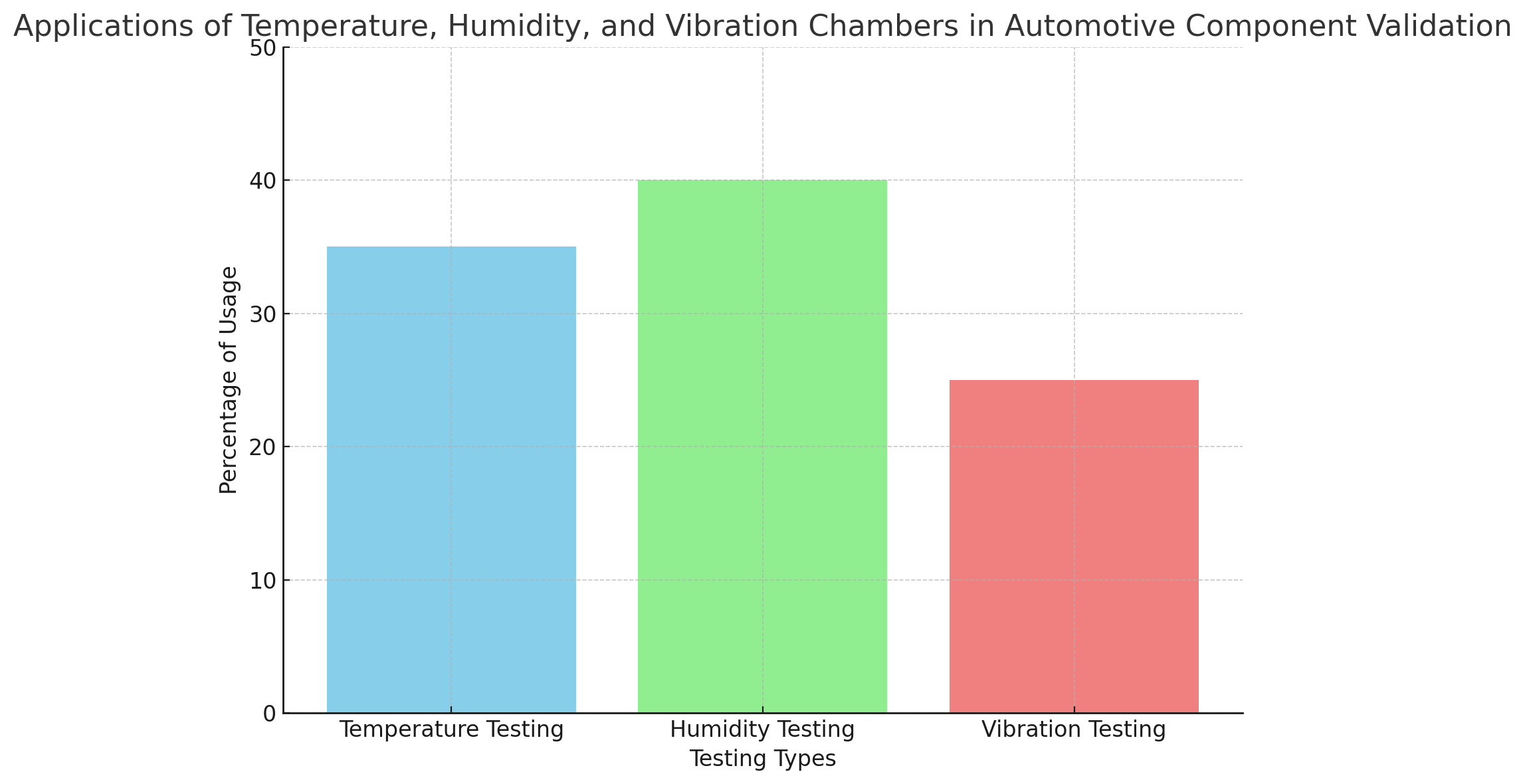
Temperature, humidity, and vibration chambers are widely used across various applications in the automotive sector:
● Battery Testing for Electric Vehicles (EVs): EV batteries are tested in extreme temperatures and humidity conditions to ensure they can function optimally under a wide range of driving conditions.
● Electronic Component Testing: Components like sensors, wiring, and control systems are subjected to environmental tests to ensure they maintain reliability and functionality.
● Mechanical Part Validation: Parts like suspension systems, rubber seals, and brake systems are tested for durability, vibration resistance, and performance under temperature variations.
These chambers allow manufacturers to test the performance, durability, and safety of automotive components throughout their lifecycle, from prototype to production.
Benefits of Using Temperature/Humidity/Vibration Chambers for Automotive Testing
Improving Component Durability and Reliability
The primary advantage of temperature, humidity, and vibration chambers is their ability to simulate the harsh environments automotive parts will encounter in real-world use. By exposing parts to extreme conditions in these chambers, manufacturers can identify potential weaknesses and improve durability. The tests help ensure that components, such as engines, batteries, and electronics, can withstand years of use without failure.
Accelerated testing in these chambers significantly shortens the product validation cycle. Manufacturers can detect issues such as material fatigue, thermal expansion, and corrosion before the product reaches the market, ensuring that only high-quality parts make it into production.
Enhancing Safety and Compliance with Industry Standards
The automotive industry is subject to stringent safety and quality standards, including ISO, SAE, and FMVSS certifications. Temperature, humidity, and vibration chambers help ensure that automotive components meet these regulatory requirements by replicating real-world conditions in a controlled environment. These tests verify that components perform safely under varying environmental conditions, such as extreme cold, heat, and humidity.
By passing these tests, manufacturers can be confident that their products are compliant with global safety standards and will provide reliable performance in diverse environments.
Ensuring Optimal Performance in Diverse Environments
Testing in temperature, humidity, and vibration chambers ensures that automotive components perform optimally across a variety of environmental conditions. For example, components are tested to confirm that they can handle the hot, dry conditions of desert climates or the cold, wet conditions found in northern regions. This comprehensive testing guarantees that automotive parts function reliably regardless of where the vehicle is driven.
Manufacturers can also optimize parts for specific regions, ensuring that vehicles are adapted to local weather conditions, improving the overall driving experience for consumers.
Key Testing Procedures for Automotive Components in These Chambers
Temperature and Humidity Testing for Automotive Components
Temperature and humidity chambers simulate the extremes of both hot and cold climates, subjecting automotive components to a wide range of temperatures and humidity levels. For example, rubber seals are exposed to high temperatures and humidity to assess their ability to resist cracking and degradation. Engine components are tested for their performance in hot conditions, while batteries are tested at extreme cold to evaluate their charge retention and efficiency.
By testing these parts under harsh environmental conditions, manufacturers can improve their performance and longevity, reducing the risk of failures in the field.
Vibration Testing in Automotive Component Validation
Vibration testing is another key aspect of automotive component validation. Temperature, humidity, and vibration chambers replicate the vibrations that automotive components endure on the road, simulating real-world conditions such as road roughness, bumps, and impacts. Parts like suspension systems, electrical connectors, and wiring are subjected to vibration tests to ensure they can withstand the stresses of daily driving.
By integrating temperature and vibration tests, manufacturers can simulate the combined effects of environmental stressors, allowing them to assess how components perform under real-world conditions.
Performance Metrics and Failures Identified through Testing
Temperature, humidity, and vibration chambers provide valuable performance metrics that help identify potential failures in automotive components. Common metrics include:
● Temperature Tolerance: Ensures that parts can handle extreme temperature changes without failure.
● Humidity Resistance: Tests the ability of components to resist corrosion and degradation in high-humidity environments.
● Vibration Durability: Evaluates the resilience of components against vibration-induced fatigue.
By identifying failure modes during testing, manufacturers can refine their designs and improve the overall quality of automotive parts.
Challenges and Solutions in Automotive Component Testing
Overcoming Environmental Testing Challenges
Replicating real-world conditions in the lab can be challenging. Factors such as temperature fluctuations, humidity changes, and mechanical stress can be difficult to simulate accurately. However, temperature, humidity, and vibration chambers offer an effective solution by providing controlled environments that closely mimic these conditions. Advanced chambers with faster ramp-up times, better energy efficiency, and precise monitoring systems are helping manufacturers overcome these challenges.
Addressing Material Failures in Automotive Testing
One of the key challenges in automotive testing is identifying material failures, such as cracking, rusting, and fading, which can be caused by environmental exposure. Temperature, humidity, and vibration chambers help manufacturers identify material weaknesses early by exposing components to accelerated environmental conditions. This proactive approach ensures that materials can withstand the stresses of real-world driving and prevents costly recalls.
Enhancing Test Accuracy and Efficiency
Modern technologies, such as automated testing systems and advanced sensors, are improving the accuracy and efficiency of automotive component testing. These innovations allow for more precise testing, reducing the margin of error and speeding up the validation process. Real-time data monitoring also enables manufacturers to track test progress and identify potential issues in real time.
Future Trends in Automotive Component Testing Using Environmental Chambers
Innovations in Temperature, Humidity, and Vibration Chambers
The future of temperature, humidity, and vibration chambers is driven by technological advancements, such as faster ramp-up times, improved energy efficiency, and the integration of artificial intelligence (AI). These innovations will enhance the testing process by making it more precise, faster, and cost-effective. The future chambers will also provide more comprehensive data, helping manufacturers optimize component designs even further.
Impact of AI and Automation on Testing Accuracy
AI and automation are already playing a significant role in improving the accuracy of automotive component testing. These technologies can predict potential failures, optimize test schedules, and analyze test data more efficiently. By integrating AI into testing systems, manufacturers can reduce human error, improve testing consistency, and accelerate product development cycles.
The Growing Importance of Electric Vehicle (EV) Testing
With the rise of electric vehicles (EVs), testing the performance of EV components, especially batteries, has become increasingly important. Temperature, humidity, and vibration chambers will play a crucial role in validating the performance, efficiency, and safety of EV batteries under extreme environmental conditions. As the EV market continues to grow, these chambers will be essential in ensuring the reliability of electric vehicles.
Conclusion
Temperature, humidity, and vibration chambers are essential for validating automotive components, ensuring they perform reliably in extreme conditions. These chambers help improve durability, meet industry standards, and optimize performance. As technology advances, these testing systems will become more efficient and accurate. Manufacturers using advanced systems like those from DANBLE will enhance their ability to deliver safe, reliable, and high-performing vehicles.
FAQ
Q: What are Temperature, Humidity, and Vibration Chambers used for in automotive component validation?
A: Temperature, Humidity, and Vibration Chambers simulate extreme environmental conditions to test automotive components like engines, brakes, and electronics. These tests ensure durability, safety, and optimal performance in real-world driving scenarios.
Q: How do Temperature, Humidity, and Vibration Chambers improve automotive component reliability?
A: By exposing automotive parts to controlled extremes of temperature, humidity, and vibration, these chambers help identify weaknesses early, improving durability and ensuring components perform reliably under various conditions.
Q: Why is testing automotive parts in Temperature, Humidity, and Vibration Chambers important?
A: Testing in these chambers ensures that automotive components meet industry standards, can withstand harsh conditions, and provide long-lasting, high-performance results, ultimately increasing vehicle safety and reliability.
Q: Can Temperature, Humidity, and Vibration Chambers be used for electric vehicle (EV) battery testing?
A: Yes, these chambers are essential for testing EV batteries, ensuring they perform efficiently and safely under temperature extremes and varying humidity conditions, which is crucial for their longevity and overall vehicle safety.
Q: How does Temperature, Humidity, and Vibration Chambers testing help with regulatory compliance?
A: These chambers allow manufacturers to test automotive components under conditions specified by regulatory bodies, ensuring compliance with industry standards like ISO, SAE, and FMVSS, crucial for safety and market readiness.