Deploying untested electronics in unpressurized environments introduces severe financial and safety risks. Aerospace, defense, and high-altitude commercial applications rely heavily on commercial off-the-shelf and specialized electronic components. When atmospheric pressure drops significantly, these components face unpredictable thermal behavior, dielectric breakdown, and mechanical deformation. Operating in rarefied air fundamentally alters how hardware functions, making standard sea-level testing entirely inadequate. Rigorous low pressure testing serves as the only verifiable method for risk mitigation. You must expose components to simulated high-altitude conditions to identify design flaws before deployment. Executing these standardized testing procedures requires a precisely calibrated Low Pressure Test Chamber. This equipment allows engineers to simulate real-world operational extremes safely. By controlling pressure reduction rates and holding steady-state vacuums, testing teams can gather actionable failure data.
Failure Predictability: Low pressure environments fundamentally alter thermal dissipation and dielectric strength, making standard sea-level testing inadequate for high-altitude electronics.
Compliance is Non-Negotiable: Adhering to standards like MIL-STD-810 and RTCA DO-160 requires precise control over pressure reduction rates and steady-state holds.
Combined Environments Matter: The most accurate failure data comes from testing pressure and temperature simultaneously, dictating specific chamber configurations.
Chamber Selection Drives Test Integrity: Evaluating a low pressure test chamber requires scrutinizing pump-down rates, vacuum pump types, safety mechanisms, and live-load feedthrough capabilities to ensure valid, repeatable data.
Table of Contents
How Low Air Pressure Impacts Electronic Parts
Thermal Dissipation Challenges in Rarefied Air
Air density decreases as altitude increases. This reduction directly impacts the convective cooling efficiency of electronic components. At sea level, dense air molecules absorb and carry heat away from active circuits. In a low-pressure environment, fewer air molecules exist to facilitate this heat transfer. Components that operate safely within thermal limits on the ground can experience rapid thermal runaway at altitude. Microprocessors, power transistors, and voltage regulators generate constant heat. Without adequate convection, this heat accumulates within the component packaging.
You must perform live-load testing to measure actual operating temperatures in a vacuum. Powering the device during the test reveals how quickly thermal limits are exceeded. Engineers often discover that conduction cooling paths designed for sea-level operation fail under high-altitude conditions. For example, a standard DC-DC converter rated for 50 watts at sea level might only safely dissipate 20 watts at 40,000 feet. To mitigate this, engineers follow specific thermal derating steps:
Calculate the maximum power dissipation of the component under full load.
Determine the thermal resistance of the component package to the ambient environment.
Apply a derating curve based on the target altitude and expected ambient temperature.
Design a conductive heat sink or cold plate to replace the lost convective cooling capacity.
Dielectric Breakdown and Corona Discharge (Paschen's Law)
Paschen's Law defines the breakdown voltage of a gas between parallel plates as a function of pressure and gap distance. Lower air pressure reduces the insulating properties of the surrounding air. As atmospheric pressure drops, the voltage required to cause an electrical arc decreases significantly. This phenomenon directly affects printed circuit board trace spacing and high-voltage components.
When the air's dielectric strength weakens, arcing and corona discharge occur. Corona discharge manifests as a luminous plasma around conductors, ionizing the surrounding gas. This ionization creates a conductive path where none should exist. Catastrophic short circuits follow rapidly. Power supplies, RF transmitters, and high-voltage transformers face the highest risk. Designing for high altitude requires increasing physical clearance between conductors or utilizing specialized conformal coatings to prevent arcing.
Altitude (Feet) | Atmospheric Pressure (Torr) | Relative Dielectric Strength |
|---|---|---|
Sea Level | 760 | 100% |
10,000 | 523 | ~70% |
30,000 | 226 | ~30% |
50,000 | 87 | ~11% |
Mechanical Stress and Hermetic Seal Compromise
Low atmospheric pressure creates pressure differences between sealed electronic components and their surroundings, potentially causing casing deformation, seal damage, or electrolyte leakage. Batteries, capacitors, and MEMS devices may be particularly sensitive. Altitude and decompression testing helps evaluate structural integrity and component reliability under changing pressure conditions.
Standardized Low Pressure Testing Procedures
MIL-STD-810 (Method 500.6) Compliance
MIL-STD-810 Method 500.6 evaluates equipment performance under low-pressure conditions associated with high-altitude storage, transportation, and operation. It includes four testing procedures:
Procedure I: Low-pressure storage.
Procedure II: Low-pressure operation.
Procedure III: Rapid decompression.
Procedure IV: Explosive decompression.
These tests help assess equipment functionality, structural strength, and pressure resistance under specified conditions.
RTCA DO-160 (Section 4) for Airborne Equipment
RTCA DO-160 Section 4 establishes temperature and altitude testing requirements for airborne equipment. Testing conditions vary according to aircraft installation location and operating environment. Steady-state altitude and pressure-change tests help verify that avionics and electronic components maintain reliable performance during flight.
Rapid Decompression vs. Steady-State Altitude Testing
Testing methodologies differ significantly based on the simulated scenario. Rapid decompression testing simulates a catastrophic failure of an aircraft's pressurized hull. The pressure drops from a standard cabin altitude to the actual external altitude in seconds. This test primarily evaluates mechanical integrity and explosive rupture risks. Steady-state altitude testing simulates prolonged exposure to high-altitude environments. This focuses on thermal dissipation and dielectric breakdown over time.
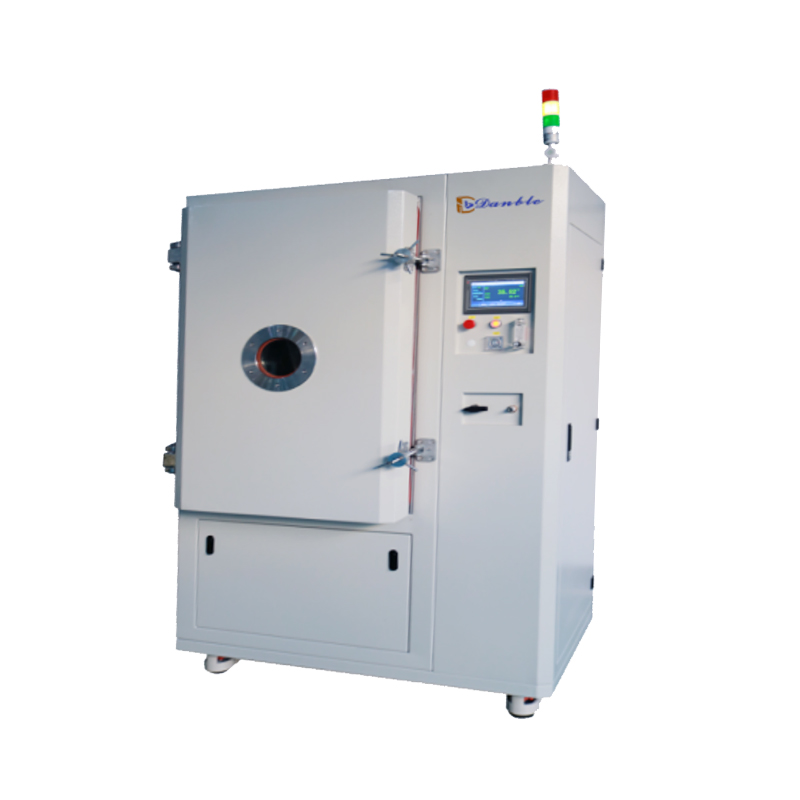
Executing rapid decompression tests accurately requires a specialized Low Pressure Test Chamber. The system must possess high-capacity vacuum pumps and rapid-acting pneumatic valves. The pump-down rates must strictly align with the precise timing curves defined by the compliance standards. A standard altitude chamber designed only for steady-state testing will fail to meet the aggressive pressure drop rates required for explosive decompression profiles.
Typical Electronic Failures Found in Low-Pressure Tests
Outgassing of Potting Compounds and Plastics
Outgassing occurs when adhesives, coatings, and plastics release trapped gases under low pressure. These vapors may contaminate optical surfaces or electrical contacts, affecting equipment reliability. Selecting low-outgassing materials and referencing ASTM E595 criteria, such as TML below 1.0% and CVCM below 0.1%, helps reduce contamination risks.
Electrolytic Capacitor Leakage and Rupture
Electrolytic capacitors may experience seal deformation, electrolyte leakage, or performance degradation under reduced atmospheric pressure. Common warning signs include bulging, increased equivalent series resistance (ESR), and reduced capacitance. Using suitable solid-state capacitors or altitude-rated components can improve reliability in low-pressure environments.
PCB Delamination and Solder Joint Fatigue
PCB delamination can occur when trapped moisture or gases expand under low pressure, potentially damaging internal layers and electrical connections. Combined temperature changes may also increase solder joint fatigue. Proper moisture control, material selection, and thermal management help prevent structural damage and maintain reliable circuit performance during altitude testing.
How to Choose a Low Pressure Test Chamber
Altitude vs. Temperature-Altitude Chambers (Combined Environments)
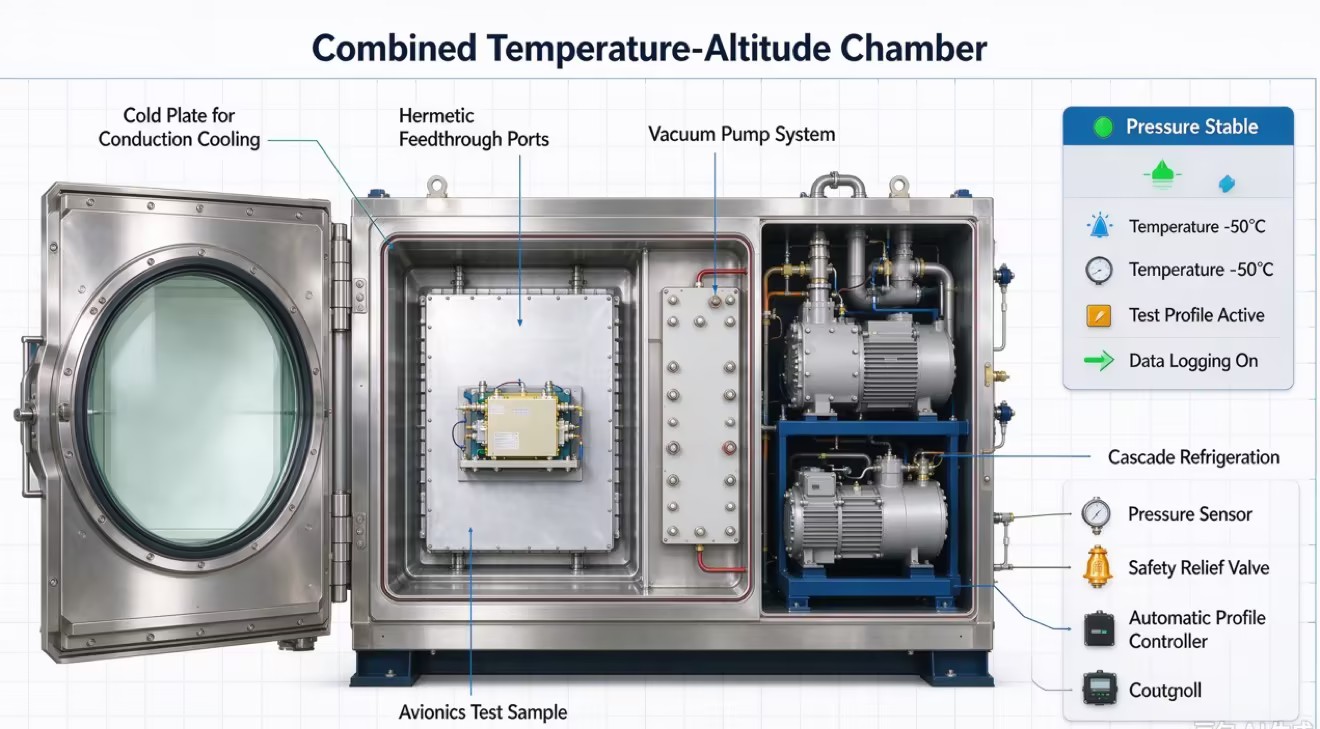
Altitude chambers simulate reduced atmospheric pressure, while temperature-altitude chambers control both pressure and temperature. Combined systems can simulate extreme conditions, including temperatures as low as −70°C, depending on equipment specifications. They are suitable for aerospace electronics and components requiring simultaneous low-pressure and low-temperature testing.
Vacuum Pumping Systems: Rotary Vane vs. Dry Scroll Pumps
Vacuum pump selection affects chamber performance, maintenance, and contamination risks. Rotary vane pumps provide reliable vacuum performance but require oil maintenance, while dry scroll pumps offer oil-free operation with reduced contamination risks.
Feature | Rotary Vane Pump | Dry Scroll Pump |
|---|---|---|
Operation | Oil-sealed | Oil-free pumping mechanism |
Maintenance | Oil and filter replacement | Periodic tip seal maintenance |
Contamination Risk | Possible oil backstreaming | Lower oil contamination risk |
Best Application | General vacuum testing | Clean-sensitive testing |
Sizing, Feedthroughs, and Live-Load Testing Capabilities
Chamber sizing depends on the dimensions of the Device Under Test (DUT), required clearance, and environmental conditions. Live-load testing requires hermetically sealed feedthroughs for power, temperature sensors, and data connections. Proper chamber capacity and feedthrough selection help maintain vacuum stability and accurate measurements.
Control Systems, Data Logging, and LIMS Integration
Automated control systems manage programmed pressure and temperature profiles while recording test data. Digital controllers, secure data logging, and Laboratory Information Management System (LIMS) integration support traceable test records, remote monitoring, and efficient compliance reporting.
Safety Mechanisms and Hazard Mitigation
Low-pressure test chamber safety requires appropriate pressure protection, emergency shutdown controls, and application-specific safeguards. Testing lithium-ion batteries or other hazardous devices may require reinforced containment, controlled venting, gas monitoring, and suitable fire protection. Proper safety interlocks and operator training help reduce equipment and personnel risks.
Conclusion
Audit your current testing capabilities to identify gaps in your altitude qualification process and ensure compliance with MIL-STD-810 or DO-160.
Review historical component failure data to determine if low-pressure environments contributed to field returns or thermal runaway incidents.
Calculate the required internal volume and feedthrough specifications based on the physical dimensions and power requirements of your largest test subjects.
Consult with a chamber manufacturer to specify pump capacities, cascade refrigeration requirements, and safety mechanisms tailored to your exact testing profiles.
FAQ
Q: What is a low pressure test chamber?
A: It is a specialized enclosure connected to a vacuum pumping system. Engineers use it to simulate high-altitude or space environments by removing air and reducing internal atmospheric pressure. Many models also include temperature controls for combined environmental testing, allowing teams to replicate the extreme cold and low pressure found in the stratosphere.
Q: How does low atmospheric pressure affect electronic components?
A: Low pressure reduces convective cooling, leading to rapid overheating. It also lowers the dielectric strength of air, causing electrical arcing and short circuits across circuit board traces. Finally, it creates severe mechanical stress on sealed components like electrolytic capacitors, leading to seal fatigue, fluid leakage, or explosive rupture.
Q: What is the difference between an altitude chamber and a vacuum chamber?
A: Altitude chambers simulate environments up to 200,000 feet and often include temperature and humidity controls for aerospace testing. High-vacuum chambers reach much deeper vacuum levels and are primarily used for space simulation, material outgassing, or physics research. Altitude chambers focus on rapid pressure changes, while vacuum chambers focus on ultimate depth.
Q: Why is live-load testing important in a low pressure test chamber?
A: Powering the device during the test is the only way to observe thermal runaway and corona discharge. These failures only occur when the circuits are active and generating heat or voltage. Unpowered storage tests cannot identify operational flaws caused by rarefied air, making live-load testing mandatory for accurate qualification.
Q: How do you prevent overheating during low pressure testing?
A: Since convective cooling fails in a vacuum, you must rely on conduction. Engineers mount the powered devices on liquid-cooled cold plates or conductive thermal fixtures inside the chamber. This setup accurately simulates the real-world heat sinks used in the actual aircraft, preventing false failures caused by the artificial vacuum environment.