In aerospace, automotive, and defense manufacturing, simulating extreme atmospheric conditions is a strict regulatory requirement. Engineering and procurement teams frequently struggle to align theoretical test requirements—often provided in feet or meters of altitude—with the mechanical specifications of testing equipment rated in kPa, Torr, or mbar. Miscalculating this conversion leads to under-specifying vacuum pump capacities, failing compliance audits, or purchasing inadequate equipment. This guide provides the exact formulas to convert altitude to kilopascals (kPa), explains the thermodynamic variables involved, and outlines a rigorous framework for evaluating and selecting a High Altitude Test Chamber capable of meeting your specific testing parameters.
Standardized Conversion is Critical: Accurate conversion from altitude to kPa using the standard barometric formula is the foundational step in specifying vacuum pump capacity and chamber structural integrity.
Temperature Interdependence: Pressure does not drop in isolation; evaluating a high altitude test chamber requires assessing its ability to manage rapid temperature fluctuations alongside extreme low-pressure environments.
Compliance Dictates Specs: Industry standards like MIL-STD-810 and RTCA DO-160 define the exact kPa thresholds and ramp rates your chamber must achieve, directly influencing procurement shortlists.
Table of Contents
How Altitude Test Chambers Work
Defining the Testing Environment
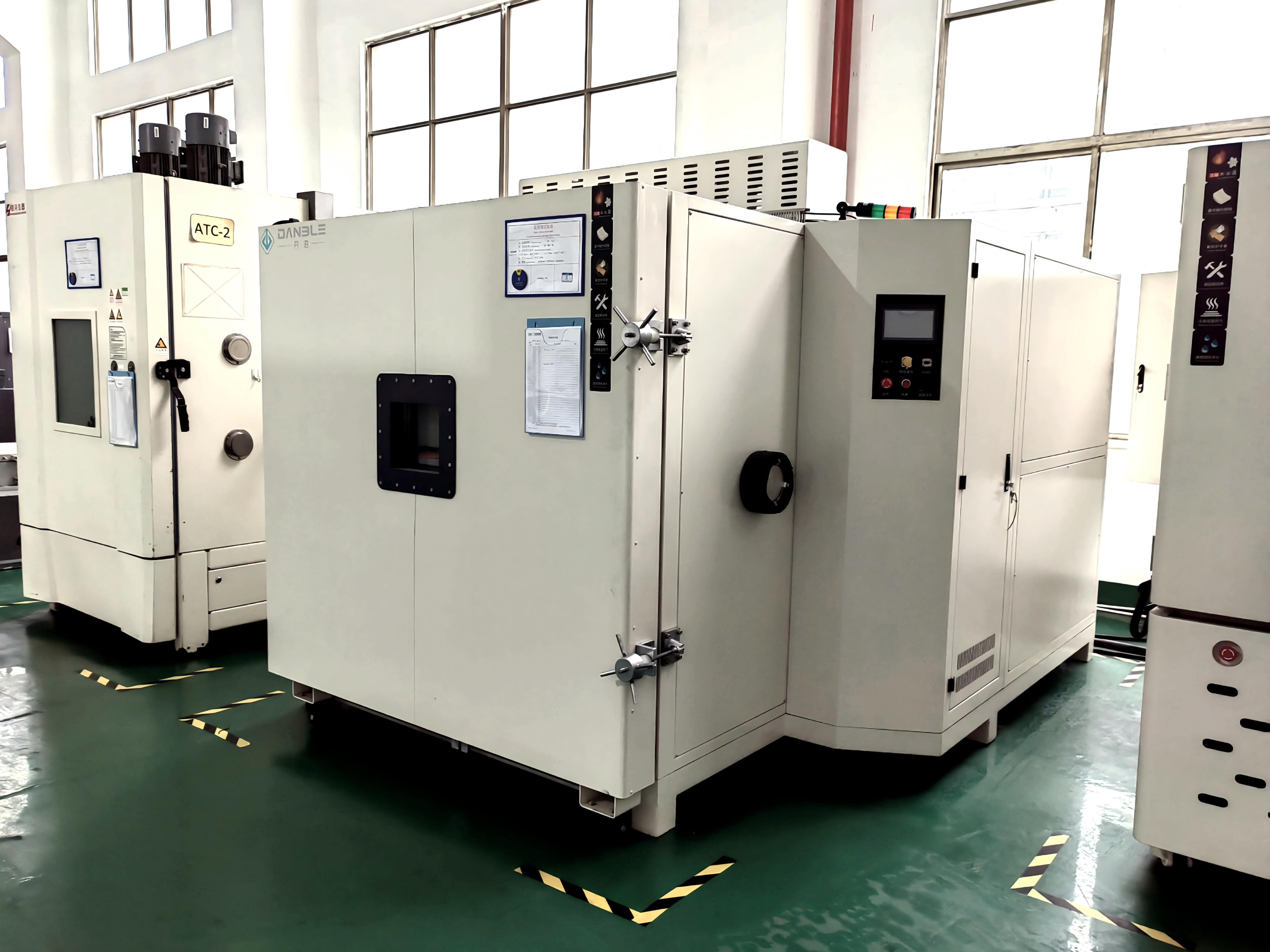
Altitude test chambers use vacuum pumps to reduce internal air pressure and simulate high-altitude conditions. Reinforced chamber walls, reliable vacuum seals, and leak-tested welds ensure structural integrity. As pressure decreases, changes in heat transfer and electrical insulation can affect equipment performance, making accurate pressure control essential.
Why kPa is the Engineering Standard
Kilopascals (kPa) provide a standardized unit for measuring atmospheric pressure in altitude testing. They simplify chamber programming, equipment specifications, and engineering calculations. Other common units include:
1 kPa = 10 mbar = 10 hPa
101.325 kPa = Standard sea-level atmospheric pressure
1 psi ≈ 6.895 kPa
Using consistent pressure units helps reduce conversion errors and improves testing accuracy.
The Thermodynamics of Altitude
Atmospheric pressure decreases as altitude increases because the weight of the air above becomes smaller. Temperature also influences air density and pressure distribution. During chamber evacuation, reduced air density limits convective heat transfer, while pressure changes may affect gas temperature. Accurate pressure and temperature control helps reproduce realistic altitude conditions.
How to Convert Altitude to Pressure (kPa)
The Standard Barometric Formula
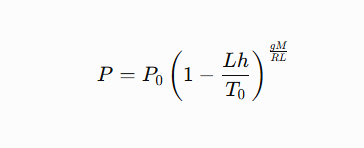
The standard barometric formula converts altitude into atmospheric pressure under defined standard-atmosphere conditions. It is commonly used to establish altitude chamber pressure setpoints.
Where:
P₀: Sea-level pressure (101.325 kPa)
h: Altitude (m)
L: Temperature lapse rate (0.0065 K/m)
T₀: Sea-level temperature (288.15 K)
P₀: Sea-level pressure (101.325 kPa)
h: Altitude (m)
L: Temperature lapse rate (0.0065 K/m)
T₀: Sea-level temperature (288.15 K)
For example, an altitude of 30,000 ft (9,144 m) corresponds to approximately 30.1 kPa under the standard atmosphere model.
Simplified Conversion Frameworks & Aviation Standards
Simplified altitude-pressure formulas provide quick estimates for preliminary calculations and equipment setup. Common methods include:
Method | Application |
|---|---|
Standard Barometric Formula | Altitude chamber pressure calculations |
Isothermal Logarithmic Formula | Approximate altitude estimation at constant temperature |
Aviation Pressure Altitude Formula | Flight-related pressure altitude calculations |
For formal testing, engineers should use the atmospheric model and pressure conditions specified by the applicable test standard rather than relying solely on simplified estimates.
Standard Altitude to kPa Benchmarks
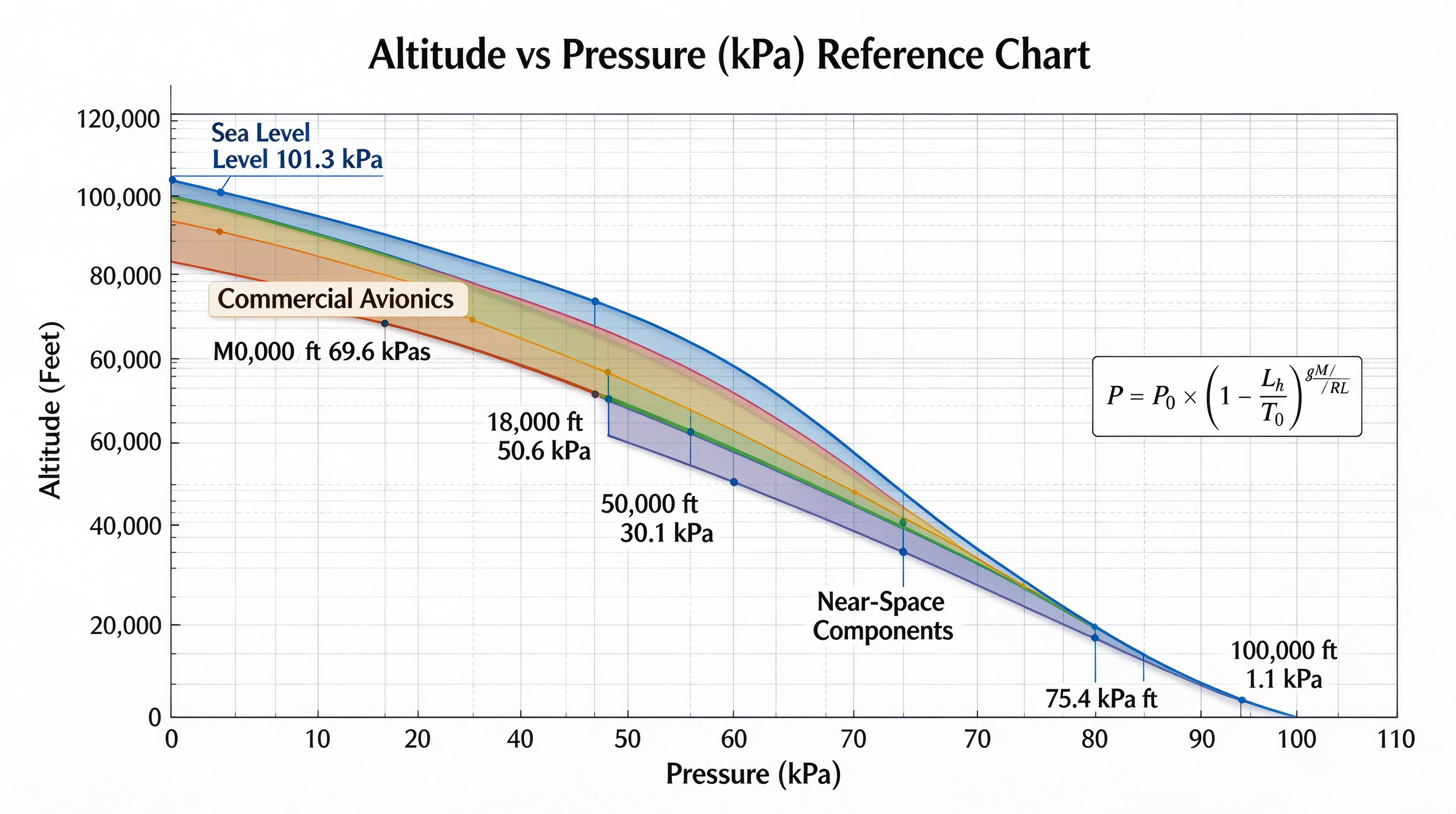
Having a quick reference guide accelerates the specification process. The table below outlines standard altitude benchmarks and their corresponding pressure values in kPa. Use this data to cross-reference your test requirements with equipment capabilities.
Altitude (Feet) | Altitude (Meters) | Approximate Pressure (kPa) | Common Testing Application |
|---|---|---|---|
Sea Level | 0 m | 101.3 kPa | Baseline calibration and standard operation. |
10,000 ft | 3,048 m | 69.6 kPa | Cabin pressure simulation for commercial flights. |
18,000 ft | 5,486 m | 50.6 kPa | Half of sea-level pressure; unpressurized cargo limits. |
30,000 ft | 9,144 m | 30.1 kPa | Standard cruising altitude for commercial aviation. |
50,000 ft | 15,240 m | 11.6 kPa | Military aircraft and high-altitude drone testing. |
75,000 ft | 22,860 m | 3.4 kPa | Weather balloon components and specialized defense systems. |
100,000 ft | 30,480 m | 1.1 kPa | Near-space applications and satellite component testing. |
How to Evaluate Altitude Chamber Specifications
Matching Vacuum Capacity to Target kPa
Vacuum pump selection depends on the target pressure, chamber volume, and required pump-down speed. Rotary vane pumps are suitable for general altitude testing, while dry scroll pumps offer cleaner operation. Booster systems can improve pumping speed for large chambers or rapid pressure reduction. Engineers should evaluate pump performance curves to ensure the system meets the required pressure and decompression profiles.
Thermal Control in Low-Density Air
Thermal control becomes more challenging at low atmospheric pressure because reduced air density limits convective heat transfer. Conductive cooling plates, radiant heaters, and advanced PID controllers help maintain stable DUT temperatures. Proper coordination between vacuum and temperature systems improves test accuracy and reduces thermal stress.
Air Volume, Airflow, and Payload Considerations
Chamber volume and DUT characteristics directly affect pump-down time and temperature stability. Large payloads reduce available air volume, while heavy components require longer thermal stabilization. Proper chamber sizing, airflow distribution, and payload positioning help maintain consistent testing conditions during pressure and temperature transitions.
Compliance, Standards, and Success Criteria
Meeting Aerospace and Defense Standards
Altitude testing chambers should meet the pressure and decompression requirements specified by relevant industry standards. MIL-STD-810 Method 500.6 covers storage, operation, rapid decompression, and explosive decompression testing. RTCA DO-160 Section 4 addresses temperature and altitude conditions for airborne equipment. Chamber capabilities should match the applicable test procedure and product requirements.
Data Logging and Sensor Accuracy
Accurate pressure measurement and data logging are essential for reliable altitude testing. Suitable pressure sensors, including capacitance manometers and Pirani gauges, support different vacuum ranges. Automated systems should record pressure, temperature, and exposure time while providing traceable reports and secure data export for compliance verification.
Altitude Testing Risks and Solutions
Outgassing and Material Deformation
Outgassing occurs when materials release trapped gases or volatile compounds under reduced pressure, potentially contaminating the chamber and affecting vacuum stability. Cold traps, low-outgassing materials, and appropriate chamber cleaning or bake-out procedures help minimize contamination and maintain reliable test conditions.
Vacuum Pump Maintenance and Longevity
Regular vacuum pump maintenance helps prevent performance loss and unexpected downtime. Oil-sealed pumps require oil changes, filter replacement, and moisture control, while dry pumps reduce oil contamination risks. Routine inspection of seals, exhaust systems, and pump performance supports reliable long-term operation.
Facility Utilities and Installation Constraints
Altitude chamber installation requires adequate electrical power, ventilation, cooling capacity, and maintenance space. Large vacuum systems may need dedicated power supplies, cooling water, and external exhaust connections. Proper facility planning helps prevent installation delays, overheating, and operational safety risks.
Conclusion
Accurate conversion from altitude to kPa remains non-negotiable for specifying high altitude testing equipment. Relying on precise barometric calculations ensures your facility meets rigorous testing standards without incurring unnecessary capital expenses. When evaluating potential equipment, prioritize manufacturers who provide transparent pump-down curves. Demand proven compliance with MIL-STD-810 and RTCA DO-160. Ensure the system features robust thermal management designed specifically for low-pressure environments.
Map out your exact test profile requirements, including maximum altitude, temperature extremes, and required ramp rates.
Calculate the required pumping speed and specify the correct vacuum pump technology for your target kPa.
Determine the optimal thermal control method based on your payload's mass and the required low-pressure thresholds.
Audit your facility utilities to ensure adequate power, cooling water, and exhaust routing before finalizing procurement.
FAQ
Q: What is the standard atmospheric pressure at sea level in kPa?
A: The standard atmospheric pressure at sea level is exactly 101.325 kPa. Engineers also express this value as 1013.25 hPa, 29.92 inHg, or 760 Torr. This baseline metric is essential for calibrating test equipment and calculating pressure drops for altitude simulations.
Q: How do you calculate pressure altitude for test chamber specifications?
A: Engineers use the standard barometric formula for precise chamber programming. For rapid estimations, the aviation equation Elevation + (29.92 - Current Pressure) x 1000 translates physical elevation targets into pressure metrics. This helps size the vacuum pumps accurately.
Q: What is the pressure in kPa at 30,000 feet?
A: At 30,000 feet, the atmospheric pressure is approximately 30.1 kPa. This specific pressure threshold is heavily utilized in commercial aviation testing to simulate standard cruising altitudes for avionics and cabin components.
Q: How does temperature affect pressure in a high altitude test chamber?
A: According to the ideal gas law, temperature extremes alter air density. The rate of change of pressure is proportional to altitude only if temperature remains constant. Chambers must synchronize thermal and vacuum controls to maintain accurate pressure profiles during temperature fluctuations.
Q: What is the difference between an altitude chamber and a standard thermal chamber?
A: An altitude chamber includes a heavy-duty vacuum vessel and specialized pumps to evacuate air. Because air density drops, altitude chambers must shift from convective heat transfer to conductive and radiant heating methods to maintain thermal control.
Q: Can a high altitude test chamber simulate rapid decompression?
A: Yes. A chamber can simulate rapid decompression provided the vacuum system, pumps, and valves are specifically sized for high volumetric flow. The system must drop the internal kPa at rapid rates mandated by aerospace standards like RTCA DO-160.