Testing oversized, fully assembled components under simulated extreme altitudes presents a massive engineering challenge. Aerospace fuselages, electric vehicle battery packs, satellite arrays, and defense vehicles require rigorous environmental validation before deployment. Standard off-the-shelf environmental chambers fail to meet these dimensional requirements. Scaling up to a room-sized volume introduces exponential complexities. Engineers face severe hurdles in structural deflection, vacuum pump sizing, thermal management, and data acquisition.
You cannot simply build a larger box. Designing a facility capable of pulling a deep vacuum on a massive scale requires a ground-up engineering approach. The structural integrity must withstand thousands of tons of atmospheric crush force. The pumping architecture must handle immense gas loads. The thermal systems must operate effectively where convective air currents do not exist. This guide deconstructs the structural, mechanical, control, and safety frameworks required to specify, design, and procure a custom high-volume testing facility.
Structural Integrity is the Primary Bottleneck: Designing a room to withstand external atmospheric pressure when a vacuum is pulled requires specialized vessel engineering, not standard architectural construction.
Thermal Dynamics Shift at Altitude: Heating and cooling large components in a near-vacuum requires radiant thermal systems or direct conductive cooling, as convective heat transfer becomes ineffective at low air densities.
Pump Architecture Dictates Cycle Times: Selecting the right combination of roughing pumps and high-vacuum blowers is critical for achieving target altitude climb rates without over-specifying energy requirements.
Control Systems and Compliance are Critical: Meeting stringent aerospace and defense standards requires advanced Data Acquisition (DAQ) and automated control systems integrated directly into the chamber's architecture.
Safety and Facility Integration are Non-Negotiable: A high volume altitude test chamber requires dedicated foundation reinforcement, blast mitigation, and rapid repressurization protocols to protect both personnel and high-value test assets.
Table of Contents
Set Targets for Large Altitude Test Projects
Volumetric Requirements vs. Component Footprint
Engineers must define strict keep-out zones around large components. A standard rule dictates a minimum 36-inch perimeter clearance around the test article. This zone ensures proper airflow during atmospheric testing phases and provides essential space for radiant heat transfer during deep vacuum phases. Technicians need physical access clearances for sensor placement, cable routing, and visual inspections. You must calculate the mathematical relationship between total internal volume and evacuation time. The pump-down equation dictates that evacuation time directly correlates to the ratio of chamber volume to pumping speed. A larger internal volume requires exponentially larger vacuum pumps to achieve the same altitude climb rate. Every cubic foot of empty space increases the evacuation burden. You must minimize excess volume while maintaining all required operational clearances.
Altitude, Temperature, and Humidity (Climatic) Profiles
Establish your target testing parameters early in the design phase. Simulating 100,000 feet of altitude requires reaching approximately 8 Torr of absolute pressure. Combining this deep vacuum with temperature extremes from -70°C to +150°C creates severe thermal and mechanical stresses on both the chamber and the test article. You must define specific climb and dive rates in feet per minute. These rates dictate the sizing of both the vacuum pumping skids and the repressurization valves. Accurately simulating real-world operational environments prevents false passes during component validation. Rapid decompression testing requires entirely different valve architecture than standard thermal-vacuum cycling. A rapid decompression event might require dropping from 8,000 feet to 60,000 feet in under 15 seconds, demanding massive pneumatically actuated dump valves.
Industry Compliance and Testing Standards
Core regulatory standards drive the entire engineering process. Defense contractors rely heavily on MIL-STD-810 for low-pressure altitude testing. Aviation components must meet RTCA DO-160 requirements for airborne equipment. EV battery safety testing follows specific ISO and UN standards for altitude simulation. These standards dictate strict tolerances for pressure stability and temperature uniformity. Data logging frequencies must align exactly with compliance mandates. Your control system must prove it maintained these tight tolerances throughout the entire test cycle to pass site acceptance testing.
Testing Standard | Primary Industry | Key Altitude/Pressure Focus | Typical Application |
|---|---|---|---|
MIL-STD-810 (Method 500) | Defense & Military | Low pressure (altitude) transport and operation | Avionics, ruggedized ground vehicles, munitions |
RTCA DO-160 (Section 4) | Commercial Aviation | Temperature and altitude combined effects | Flight control computers, cabin electronics |
UN 38.3 | Energy Storage / EV | Altitude simulation for battery transport | Lithium-ion battery packs, EV modules |
IEC 60068-2-13 | General Electronics | Low air pressure testing | Consumer electronics, industrial sensors |
Structural Engineering of a High Volume Altitude Test Room
Managing Extreme Pressure Differentials
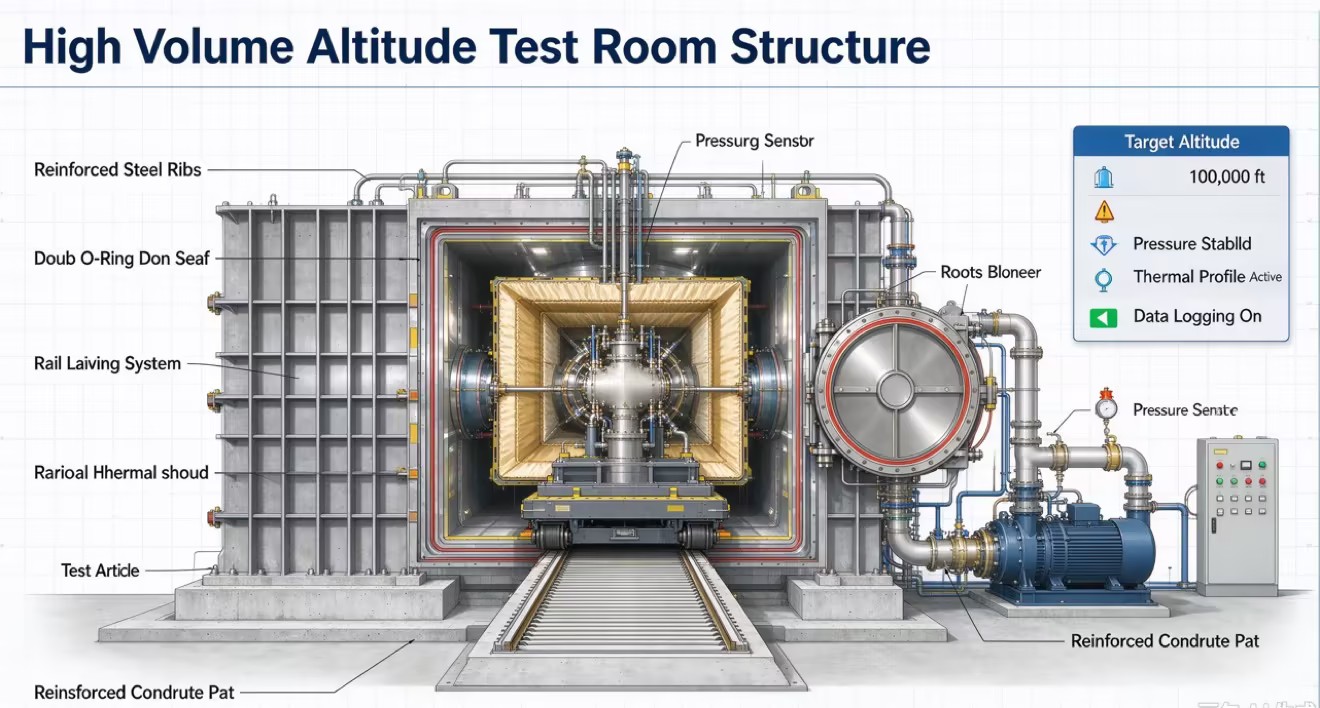
High volume altitude test rooms must withstand significant external atmospheric pressure during vacuum testing. Structural design is critical to preventing wall deformation and chamber failure.
Chamber Design | Main Advantage | Key Consideration |
|---|---|---|
Cylindrical | More efficient pressure distribution | Less flexible interior space |
Rectangular | Maximizes usable testing space | Requires reinforced walls and external supports |
Engineers use structural calculations and reinforcement systems to maintain chamber stability under the required pressure differential.
Material Selection, Weld Integrity, and Outgassing Mitigation
Material selection and welding quality directly affect vacuum integrity, corrosion resistance, and contamination control.
Carbon Steel: Suitable for many dry altitude testing applications.
Stainless Steel (304/316L): Offers improved corrosion resistance for demanding environments.
Continuous Welding: Helps prevent leakage through structural joints.
Helium Leak Testing: Detects small leaks in welds and sealing interfaces.
Outgassing Control: Cold traps or Residual Gas Analyzers (RGA) can help monitor or manage contamination.
Proper fabrication and inspection ensure reliable long-term chamber performance.
Door Design and Sealing Mechanisms for Oversized Access
Oversized chamber doors require strong structural support and reliable vacuum sealing. Hinged, sliding, or vertical-lift designs can accommodate different payload sizes and facility layouts.
Key design considerations include precision door alignment, durable O-ring seals, and accessible maintenance points. Dual O-ring systems with intermediate pumping can provide enhanced sealing performance, while regular inspection and seal replacement help maintain vacuum integrity.
Mechanical Systems and Pumping Architecture
Vacuum Pump Sizing for a High Volume Altitude Test Chamber
Large volumes require multi-stage pumping systems. Single-stage pumps cannot achieve deep vacuum levels efficiently against massive gas loads. Engineers pair rotary piston or dry screw pumps for initial roughing. These roughing pumps pull the chamber from atmospheric pressure down to approximately 10 Torr. The system then engages Roots-type blowers for high-vacuum performance to push the pressure down to the target level. You must calculate pump capacity in CFM or cubic meters per hour. This calculation relies on the total volume and the required time-to-altitude. Designing a High Volume Altitude Test chamber requires precise pump capacity calculations. You must also account for the anticipated outgassing load of the test component. Outgassing effectively adds gas volume to the chamber, slowing the climb rate significantly. Undersized pumps will stall against high outgassing loads, failing to reach the target altitude.
Thermal Management at Low Air Density
Low air density reduces convective cooling efficiency, making traditional forced-air cooling less effective during altitude testing. Engineers use alternative thermal management methods to maintain stable DUT temperatures.
Radiation Cooling: Thermal shrouds control heat transfer through radiation.
Conductive Cooling: Liquid-cooled plates transfer heat directly from components.
Low-Density Air Circulation: Suitable for moderate-altitude testing where sufficient air remains.
Advanced Control Systems and Data Acquisition (DAQ)
Advanced control systems ensure accurate and repeatable altitude testing. PLCs and HMIs manage vacuum pumps, valves, and programmed test profiles, while Data Acquisition (DAQ) systems record synchronized pressure and temperature data. Automated PID control helps maintain stable pressure transitions and supports reliable test documentation.
Site Setup and Operating Safety
Foundation and Floor Loading Considerations
Large altitude test chambers require careful structural planning due to their significant weight and concentrated floor loads. Reinforced foundations, suitable floor capacity, and specialized loading systems help ensure safe installation. For a High Volume Altitude Test Room, rail-guided carts can simplify heavy DUT handling and protect chamber components.
Emergency Repressurization and Operator Safety
Emergency safety systems protect personnel and equipment during power failures or unexpected test interruptions. Key safeguards include:
Controlled Repressurization: Prevents sudden pressure changes that could damage the DUT.
Safety Interlocks: Prevent door opening under unsafe pressure conditions.
Oxygen Monitoring: Detects potential oxygen depletion from nitrogen leaks.
Emergency Controls: Enable safe shutdown and pressure recovery.
Design Tradeoffs for Custom Chambers
Custom Build vs. Modular Expansion
Custom monolithic chambers provide strong structural integrity and fewer vacuum sealing interfaces, making them suitable for demanding aerospace applications. Modular chamber designs offer greater installation flexibility and future expansion potential but require careful sealing and structural engineering. Selection depends on chamber size, vacuum requirements, project budget, and deployment schedule.
Energy Consumption and Long-Term Maintenance
Vacuum pumps and refrigeration systems account for much of an altitude chamber's energy consumption. Variable Frequency Drives (VFDs) can improve efficiency by adjusting motor speed according to testing demand. Regular pump maintenance, seal replacement, sensor calibration, and leak inspections help maintain reliable performance and reduce long-term operating costs.
Conclusion
Draft a comprehensive User Requirement Specification (URS) detailing the exact dimensions, mass, and center of gravity of your largest expected payload.
Calculate the maximum thermal dissipation of the powered test component to size the radiant cooling shrouds and conductive cold plates accurately.
Conduct a facility structural audit to confirm concrete pad load capacities, ceiling clearances, and three-phase power availability.
Define the exact climb rates, dive rates, and required testing standards before issuing a Request for Proposal (RFP) to manufacturers.
FAQ
Q: What is the maximum practical size for a high volume altitude test room?
A: Size is limited only by facility footprint, foundation load capacity, and engineering constraints. Some aerospace facilities exceed 10,000 cubic feet. However, rectangular designs become exponentially more resource-intensive to reinforce as internal volume increases due to massive external atmospheric pressure.
Q: How long does it take to pull a vacuum in a room-sized altitude chamber?
A: Evacuation time depends entirely on the specified pump CFM and target altitude. It ranges from 15 minutes for rapid decompression testing to several hours for standard thermal-vacuum cycles involving massive test articles.
Q: What testing standards can a high volume altitude test chamber meet?
A: These chambers commonly meet MIL-STD-810G/H for low pressure, RTCA DO-160 for airborne equipment, and specific automotive standards for EV battery altitude simulation. The control system must log data according to these specific profiles.
Q: Can a high volume altitude test chamber also perform humidity testing?
A: Yes, but introducing moisture complicates vacuum testing. Condensation and freezing occur at low pressures. This requires specialized heated pumping lines, stainless steel interiors, and cold traps to protect the vacuum pumps from water vapor damage.
Q: What is the difference between an altitude room and a thermal vacuum (TVAC) chamber?
A: Altitude rooms typically simulate atmospheric flight conditions up to approximately 100,000 feet. TVAC chambers simulate deep space high vacuum using cryogenic shrouds and specialized high-vacuum pumps like cryopumps or turbomolecular pumps.
Q: How do you load multi-ton components into an altitude test room?
A: Facilities use integrated rail systems, air bearings, or specialized heavy-duty loading carts. These systems distribute the weight evenly across the reinforced chamber floor and prevent damage to the critical door vacuum seals during loading.