In semiconductor manufacturing, late-stage thermal failures carry incredibly high stakes. A single field degradation issue can cost companies millions in forced redesigns. It also heavily damages market trust. You must identify these vulnerabilities early. Effective Semiconductor R&D Validation relies entirely on your environmental test chambers. Their precision, consistency, and compliance determine your prototyping success. These chambers serve as the frontline defense during critical qualification phases.
R&D directors and testing lab managers face immense pressure here. You must evaluate, specify, and shortlist HTOL and thermal cycling chambers carefully. We will explore how you can guarantee strict standard compliance. We also explain how to avoid over-specifying your facility requirements. You will learn core evaluation dimensions for these complex machines. We cover alignment with industry standards and strategies to mitigate facility implementation risks.
Key Takeaways
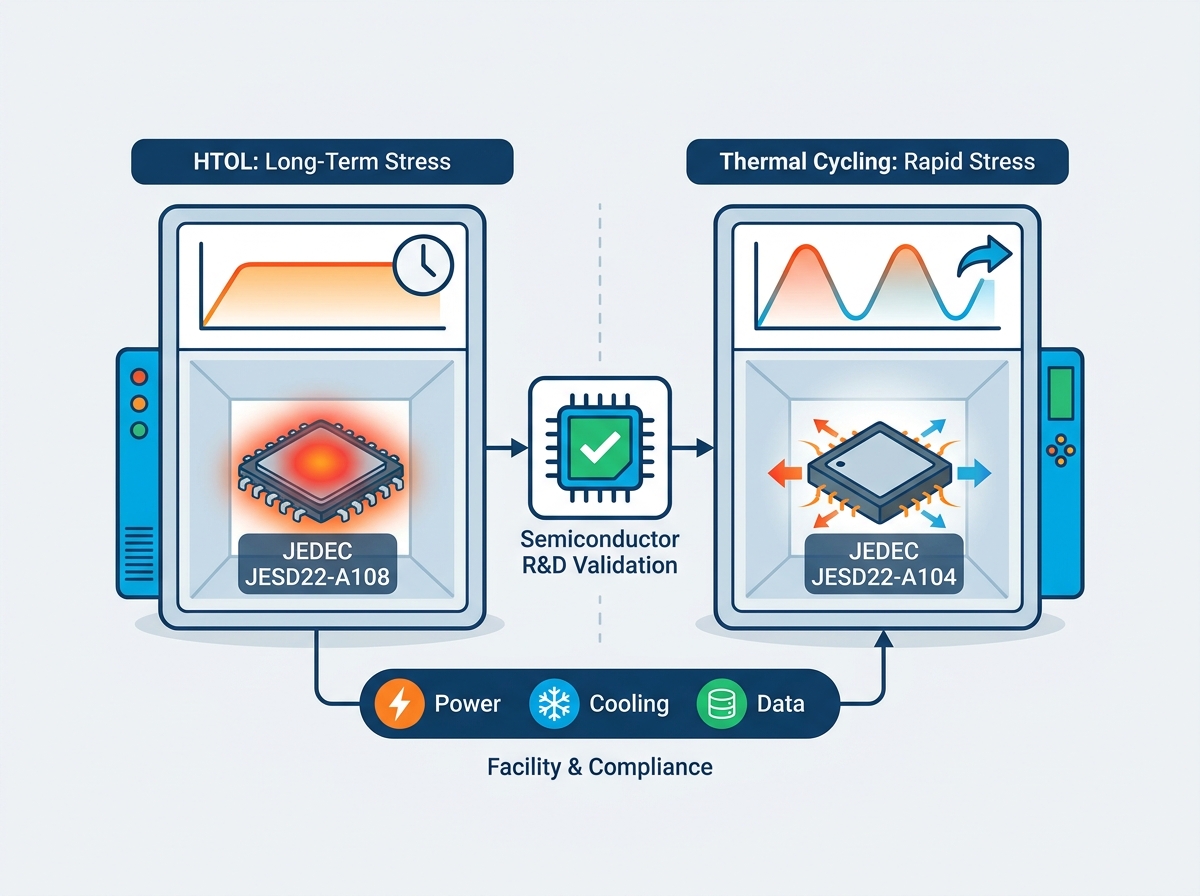
Process Distinction: HTOL focuses on long-term continuous thermal/electrical stress to predict lifespan, while thermal cycling identifies structural vulnerabilities (e.g., packaging, PCB solder joints) through rapid expansion and contraction.
Standard Compliance is Non-Negotiable: Chamber selection must be strictly reverse-engineered from intended standards (e.g., JEDEC JESD22-A104 for cycling, JESD22-A108 for HTOL).
Facility Realities dictate ROI: A chamber’s ramp rate capabilities must be balanced against the facility's available power, cooling water infrastructure, and floor space constraints.
Data Integrity: Modern validation requires chambers with closed-loop monitoring, redundant sensors, and seamless integration into lab execution systems (LES).
Defining Success Criteria for Semiconductor Thermal Validation
You build semiconductors for highly demanding industries. The automotive sector requires strict AEC-Q100 compliance. Aerospace and high-performance computing (HPC) demand verifiable proof of lifespan. You must prove thermomechanical resilience long before mass production begins. Components face extreme environments in the field. They endure relentless heat and rapid temperature shifts. You cannot rely on theoretical models alone. Physical validation remains mandatory.
Mapping Tests to Outcomes
Different test profiles isolate completely different failure mechanisms. You must match the test to your specific reliability outcome.
HTOL (High-Temperature Operating Life): This test applies sustained elevated temperatures. Profiles typically range from 125°C to 150°C. We combine this thermal stress with dynamic electrical biasing. This accelerates dielectric wear-out and electromigration. You can accurately predict the device's operational lifespan.
Thermal Cycling: This test applies rapid alternating temperature extremes. It induces severe thermomechanical fatigue. You use it primarily to validate die-attach integrity. It also tests wire bonding and PCB interconnect reliability. Components expand and contract at different rates. This identifies weak physical solder joints quickly.
Defining Success
A successful chamber investment yields highly repeatable data. It produces clean, artifact-free test results. High-quality chambers minimize false-positive failure rates. They achieve your required thermal transition speeds flawlessly. Crucially, they do this without overshooting target temperatures. Thermal overshooting artificially degrades the Device Under Test (DUT). This invalidates your entire validation run. Accurate Semiconductor R&D Validation requires absolute thermal stability.
Core Evaluation Dimensions for Test Chamber Selection
Evaluating test chambers requires a deep understanding of thermodynamics. You cannot simply buy the largest chamber available. You must align the machine's capabilities to your test loads.
Thermal Performance and Ramp Rates
We must distinguish between standard and rapid ramp rates. Standard ramp rates average 1°C to 3°C per minute. Rapid-rate thermal cycling pushes 15°C to over 20°C per minute. You might assume faster ramp rates are always better. This assumption is dangerous. Ramp rates must match the specific mass of your DUT. They must also align strictly with the required standard.
A massive payload will slow down any transition rate. You must calculate the exact thermal mass of your test boards. Only then can you specify the required heating and cooling kilowatts.
Test Chamber Application Matrix
Parameter | HTOL Testing | Thermal Cycling |
|---|---|---|
Primary Goal | Lifespan prediction via sustained stress | Structural integrity via fatigue |
Typical Temp Range | 125°C to 150°C (Static) | -55°C to 125°C (Dynamic) |
Electrical Bias | Active (Powered DUTs) | Usually Passive (Unpowered) |
Ramp Rate Priority | Low (Stability is key) | High (15°C+ per minute) |
Airflow and Temperature Uniformity
Spatial temperature variation inside the workspace is highly critical. You typically need ±0.5°C uniformity across the chamber interior. Uneven airflow leads to inconsistent DUT stressing. Some components experience higher thermal loads than others. This completely invalidates your batch results. You cannot trust data from non-uniform testing environments.
Baffle designs and fan speeds dictate this uniformity. Variable speed blowers help optimize airflow for different payloads. High-density PCB racks require aggressive air circulation. Sparse payloads need gentler airflow to maintain tight gradients.
DUT Capacity and Live-Load Handling
Evaluate how the chamber handles active heat dissipation. Powered components generate significant heat during HTOL testing. The refrigeration system must actively compensate for this wattage. Semiconductors act like tiny heaters inside the workspace. If the chamber lacks sufficient cooling capacity, temperatures run away.
You must calculate total live-load wattage accurately. Multiply the power per device by the total device count. Add a safety margin for the test fixturing. The chamber's cooling system must comfortably absorb this entire thermal load. Proper live-load handling defines robust Semiconductor R&D Validation.
Aligning Chamber Capabilities with JEDEC and MIL-STD Compliance
Standard compliance is never optional in the semiconductor industry. Customers reject components tested in non-compliant environments. You must align your equipment specifications directly with global standards.
Reverse-Engineering from Standards
You must reverse-engineer chamber specifications from published industry standards. Take JEDEC JESD22-A104 for temperature cycling. It requires highly specific soak times and transition rates. The chamber must prove the actual component reached the target temperature. It is not enough to measure just the chamber air.
MIL-STD-883 dictates even stricter rules. It mandates rigorous environmental extremes for military ICs. Aerospace components follow similarly demanding profiles. These standards dictate exact thermocouple placements. They specify allowable thermal gradients across the board. If your chamber cannot meet these profiles, your data is useless.
Compliance-Aware Calibration
Evaluate the availability of accredited calibration services thoroughly. Look for ISO/IEC 17025 certification from the chamber manufacturer. Compliance-aware calibration is essential for customer audits. You need independent, traceable thermocouple placement.
Traceability guarantees audit-proof documentation. Calibrate your sensors at least annually. High-utilization labs often switch to bi-annual calibration schedules. Drift in sensor accuracy directly compromises reliability predictions. You must document every calibration cycle rigorously in your quality management system.
Implementation Realities and Facility Risks
High-performance test chambers are not plug-and-play appliances. They demand robust facility infrastructure. Ignoring these prerequisites leads to delayed installations and failed validation timelines.
Infrastructure Prerequisites
Rapid-rate thermal chambers require significant infrastructure upgrades. You must audit your facility before signing any purchase orders. Proceed through these critical infrastructure checks systematically.
Electrical Power Draw: Rapid-rate thermal chambers require massive electrical amperage. These systems typically require 480V, 3-phase power. Older facilities rarely have this capacity available at the wall. You may need dedicated sub-panels installed.
Cooling Modalities: You must choose between air-cooled and water-cooled condensers. Relying on air-cooled systems for high-load HTOL carries risks. It can easily overload your facility HVAC systems. Water-cooled systems handle higher loads efficiently. However, they require dedicated plumbing infrastructure and chiller loops.
Floor Space and Load Bearing: Chambers carry significant physical weight. Cascade refrigeration compressors are incredibly dense. Ensure your lab flooring can support the localized load. Account for clearance space around the machine for maintenance access.
Liquid Nitrogen and CO2 Boosts
Sometimes you need ultra-fast cooling rates for specific tests. Facilities use Liquid Nitrogen (LN2) or Liquid CO2 boosts for this. These expendable refrigerants present major logistics challenges. They also introduce severe safety risks to your personnel.
You must install oxygen depletion monitors in the lab. Proper exhaust ventilation is absolutely mandatory. Storing large cryogenic dewars consumes valuable floor space. If standard mechanical refrigeration meets your standard, always prefer it. Reserve liquid boosts only for extreme MIL-STD shock requirements.
Cooling Modality Comparison
Cooling Type | Facility Impact | Performance Limit |
|---|---|---|
Air-Cooled | Dumps heat into room HVAC | Standard ramp rates only |
Water-Cooled | Requires chilled water loop | High live-loads, rapid ramps |
LN2 Boosted | Needs ventilation & O2 monitors | Ultra-fast, extreme cold limits |
Shortlisting Logic and Vendor Evaluation Framework
Selecting the right equipment partner is crucial. A poorly supported chamber becomes a massive liability. You need a vendor capable of supporting your long-term roadmap.
Custom vs. Off-the-Shelf Systems
You must decide between catalog chambers and custom builds. Standard catalog chambers offer quicker manufacturing lead times. They provide proven reliability histories across many customers. You should default to standard models whenever possible.
Custom build-outs are necessary for unique product form factors. You also need them for specialized automated handling requirements. Custom chambers require intense engineering collaboration. Expect longer delivery timelines and complex factory acceptance testing.
Service Level Agreements and Uptime
Assess vendor response times carefully. A chamber might go down during a 1,000-hour HTOL test. This failure destroys weeks of your R&D timeline. You must start the entire test over from zero.
Service Level Agreements (SLAs) guarantee rapid repair responses. Ask vendors about their local spare parts inventory. Ensure they employ factory-trained technicians in your geographic region. High equipment uptime defines successful Semiconductor R&D Validation.
Control Systems and Data Logging
Evaluate the software capabilities of the chamber controllers closely. Look for open-architecture designs. They integrate easily with existing R&D test racks. Modern labs rely on automated Lab Execution Systems (LES). Your chamber must communicate via standard industrial protocols.
You want real-time remote alarming pushed to your phone. Encrypted data exports are mandatory for compliance logs. The controller should prevent unauthorized modifications to active test profiles. Require distinct user access levels for operators and administrators.
Next-Step Actions
Initiate an engineering consultation with vendors early. Do this long before you request formal quotes. Provide them a preliminary DUT specification sheet immediately. This document guides the entire sizing process.
Include the exact mass of your test boards. Document the maximum heat dissipation during active biasing. Specify your required JEDEC or MIL-STD standards clearly. Outline your expected batch size for each run. Vendors use this data to calculate precise thermodynamic requirements.
Conclusion
Recognize test chambers as foundational validation instruments, not generic commodities.
Balance aggressive thermal performance requirements against actual facility infrastructure realities.
Prioritize open-architecture control systems to ensure seamless data integration and integrity.
Request a professional thermal calculation assessment from vendors before requesting pricing.
Draft a comprehensive DUT specification sheet today to guide your procurement process.
FAQ
Q: What is the difference between Thermal Cycling and Thermal Shock chambers?
A: Thermal cycling uses a single zone. The temperature ramps up and down at a controlled rate. Thermal shock uses physical transfer mechanisms. An elevator or basket moves the DUT between distinct hot and cold zones. This creates near-instantaneous temperature changes to test extreme vulnerability.
Q: How does the DUT's heat dissipation affect HTOL chamber sizing?
A: Active semiconductors generate continuous heat. The chamber's cooling system must have sufficient live-load capacity. It must remove this heat to maintain the target temperature. If the capacity is too low, the chamber experiences thermal runaway, destroying the test.
Q: Is liquid nitrogen (LN2) cooling necessary for semiconductor thermal validation?
A: It is rarely necessary for standard profiles. You only need it if the test standard requires cooling transition rates exceeding mechanical limits. Standard cascade refrigeration handles up to 15-20°C per minute. Anything faster typically requires expendable LN2 or CO2 cooling.
Q: How often should thermal cycling chambers be calibrated?
A: Industry best practice requires at least annual calibration. Most quality management systems like ISO 9001 demand this frequency. High-utilization R&D environments often opt for bi-annual checks. You must verify controller accuracy and spatial uniformity to ensure compliant testing.